
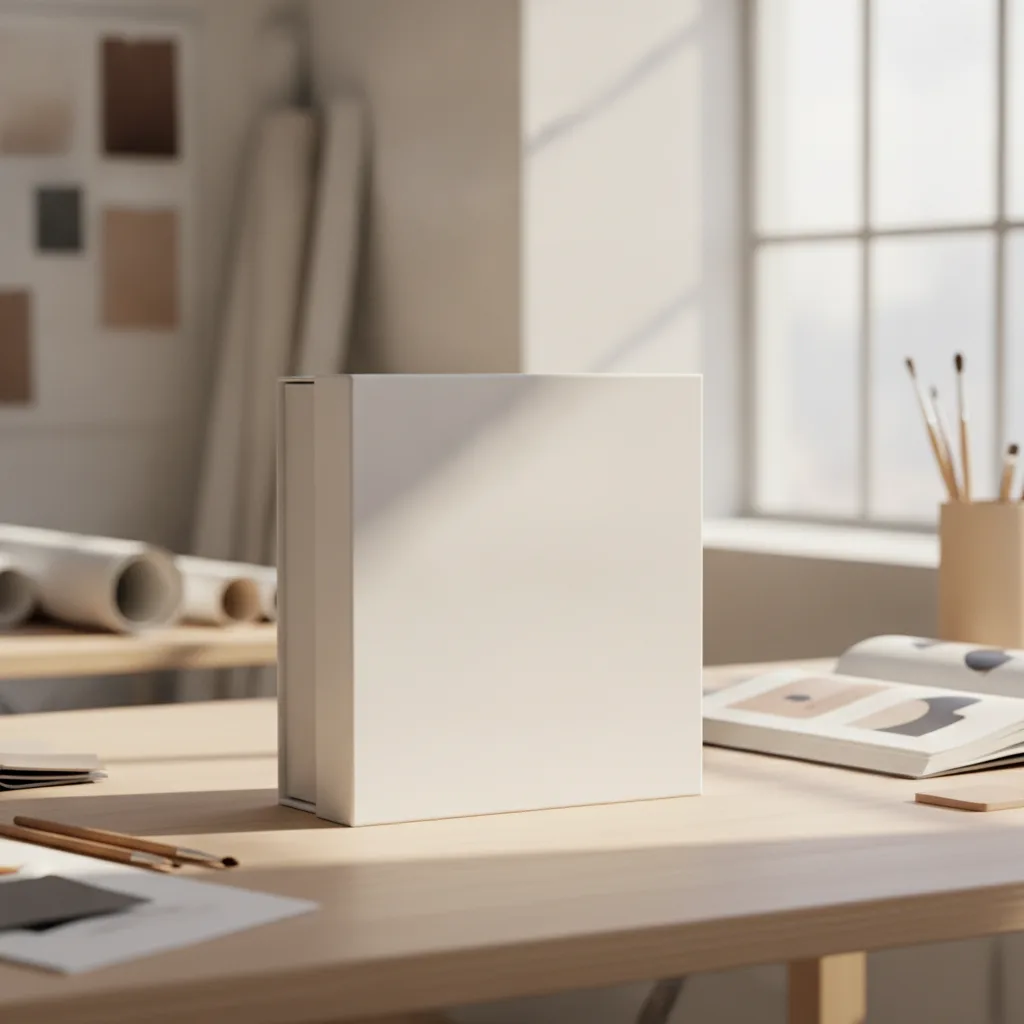
In a high-end box or case project, everyone first looks at the graphic design, the gilding, or the varnishing. Yet, it's often a much more discreet step that determines the success of the launch: the blank packaging mockup. This physical prototype, without any printed decoration, allows for validation of the volume, proportions, opening mechanisms, and ergonomics before committing printing and finishing budgets.
At the house of Maestro, It's also a key moment for dialogue between art direction, manufacturing, and marketing. A well-designed and quickly delivered white mock-up avoids unpleasant surprises at Christmas, for Fashion Week, or during a global launch.
The white packaging mockup: why this invisible step is the most important in the project
Reading time: ~12 min
- What is a white packaging mockup?
- Why the white mockup is crucial in a luxury packaging project
- How Maestro creates a faithful white model in 48 hours
- How to make the most of a white packaging mockup
- FAQ
What is a white packaging mockup?
By analogy to the white model in edition (a copy made with the right papers but without printed content), the white packaging mockup is a packaging prototype made in its future material, but completely blank.
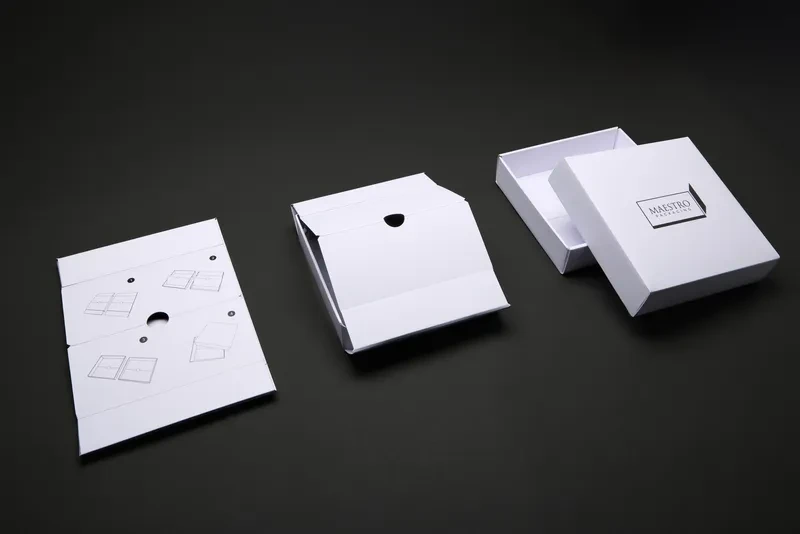
In practical terms, a white packaging mockup is:
- a box, a case, a box or a sheath made to a 1:1 scale;
- in the final cardboard or paper, with the correct thickness;
- with the same cut, the same scoring, the same folds and gluing as the final version;
- without printing, without gilding, without varnish (often entirely white).
Its main role is to test the object's real-world behavior: volume, strength, ease of opening, product retention, and logistical compatibility. We're not talking about 3D simulation or a simple 2D file here, but a physical prototype that can be manipulated, filled, opened, and closed.
This clearly distinguishes it from the printed mockup (color mockup or decorative proof) used to check color and visual placement, as well as the press proof, which comes much later, just before production begins. The white mockup arrives earlier: it's a strategic decision-making tool, used when there's still time to modify the template without impacting the entire graphic chain.
Why the white mockup is crucial in a luxury packaging project
Confirm the volume, proportions, and hand presence
On screen, a few millimeters more or less are almost invisible. In hand, on a perfume or spirits box, they make all the difference. The white model allows you to immediately gauge the object's size, the balance between wall thickness, interior space, and product volume, as well as the perceived value (a box that "sounds hollow," walls that mark too easily, a lid that's too flimsy).
Testing product retention and safety
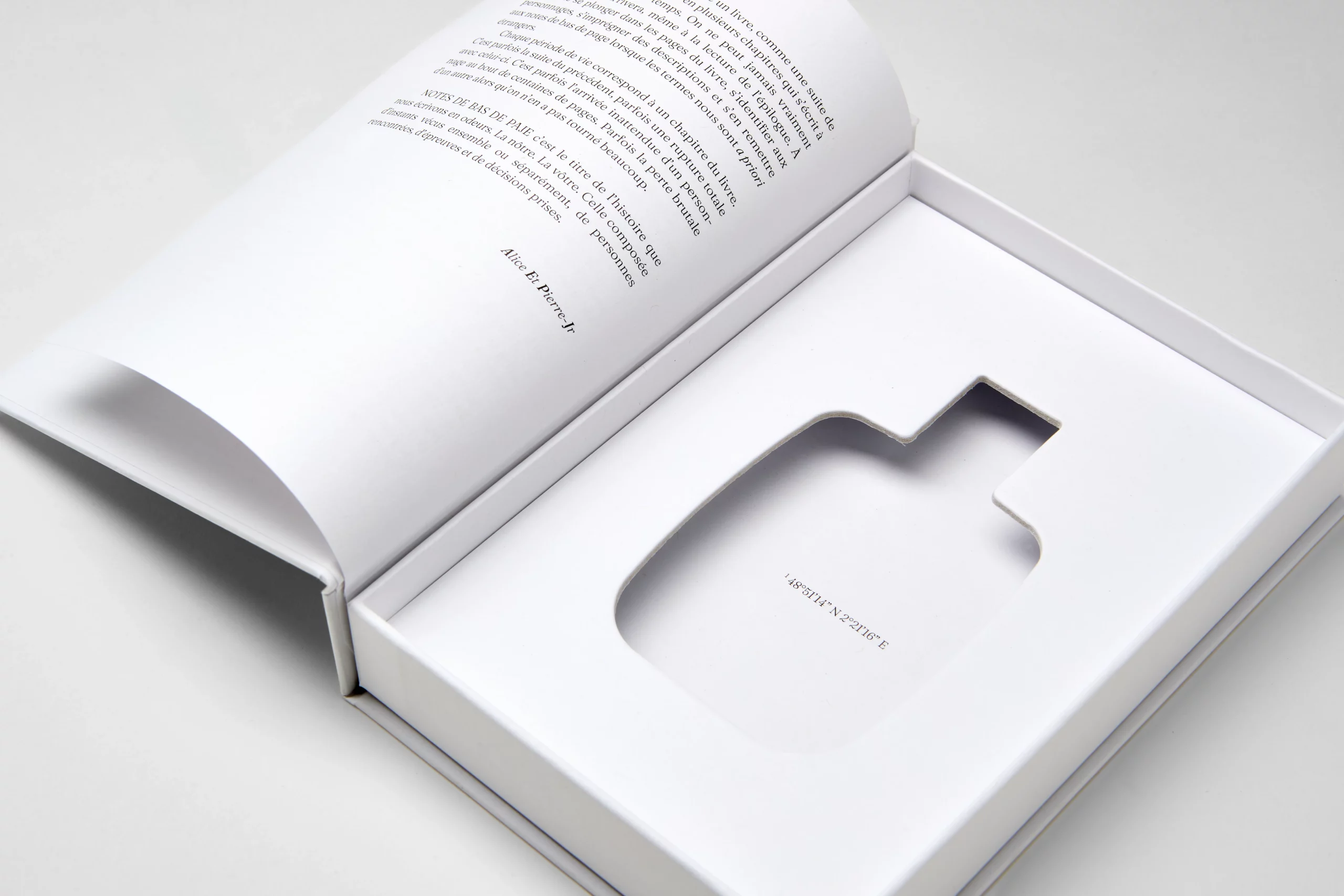
Slightly undersized packaging, a bottle holder that's too loose, or a bulging base can ruin a product launch. A well-made white mock-up allows for real-world testing of the bottle's stability, opening stability, and behavior during transport and on the shelf.
Check the opening mechanism and ergonomics
Magnetic flap, drawer, interlocking lid, nesting box… the more sophisticated the system, the greater the risk of disappointment in use. The white mock-up allows us to validate the smoothness of opening, the "access time" to the product, the ease of handling, and the behavior of the magnets or hooks.
Reduce budgetary and planning risks
The further a project progresses in the graphic design process, the more expensive each correction becomes. By validating the template in white, you secure the layouts, limit the back-and-forth of color proofs, and reduce the risk of reprints or emergency revisions as a key launch approaches (Christmas, Valentine's Day, Fashion Week).
To provide concrete support for internal arbitration
A white model is an object that is placed on the table of a management committee; it speaks as much to the art direction as to purchasing and finance, facilitating choices between architectures, cardboard thicknesses or opening mechanisms.
How Maestro creates a faithful white model in 48 hours
From paper engineering to cutting templates
The manufacturing team takes into account the type of cardboard, future finishing areas and industrial constraints to establish a cutting and folding template at 1 scale, a common basis for the model and graphic developments.
Digital cutting for maximum responsiveness
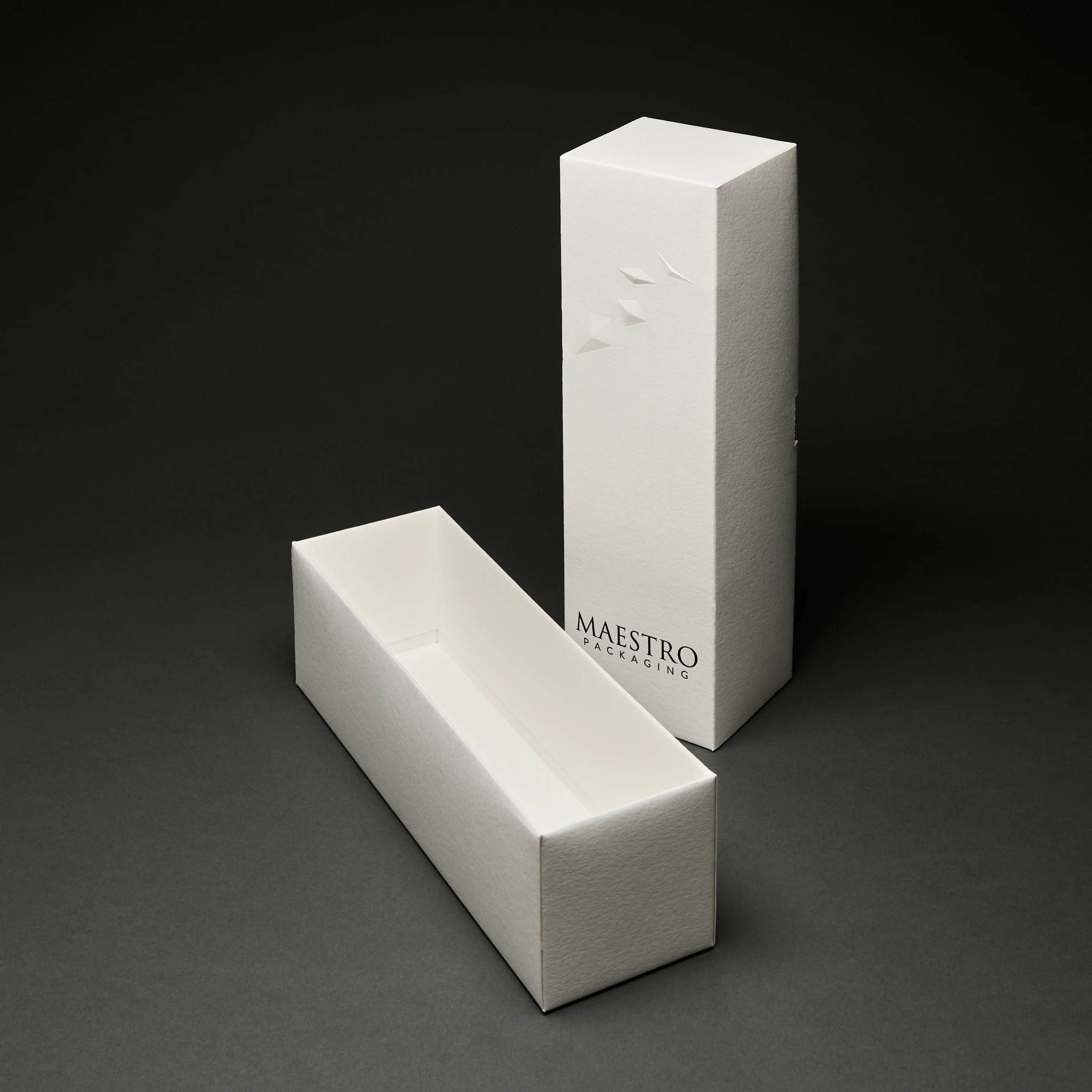
Thanks to digital cutting, no steel tooling is required at the prototype stage; the template can be adjusted and then re-edited in a few hours, even for complex geometries.
The same materials as the future box
The value of a blank model depends on its realism: same cardboard, same grain direction, same gluing methods, in order to test a true pre-series of a unit.
A bridge between creation, manufacturing and CSR
During this phase, Maestro can alert on technical incompatibilities, propose more economical variants in terms of material and document the choices of materials (FSC, recyclability) for carbon footprints and calls for tenders.
How to make the most of a white packaging mockup
List the checkpoints
Before the manipulation, define a protocol with manufacturing, creation, marketing and purchasing, in order to systematically review the main control points of a blank packaging mockup.
| Checkpoint | What to observe |
|---|---|
| Getting started | Weight, rigidity, comfort |
| Opening / closing | Hardness, noise, alignment |
| Product maintenance | Test with actual product or weight model |
| Behavior during transport | Bumps, moderate falls, piling up |
| Readability of future decor areas | Visible faces, security zones |
Testing in real-world conditions
Place the model on the shelf next to competitors, in a gift box or on a press table; this contextualization reveals problems invisible in the office (lack of presence, difficulty of storage, confusion of ranges).
Anticipate the adaptation to multiple formats
From the prototype stage, check the possibility of enlarging or reducing the template without changing the material, the impact on rigidity and the limitations of machines in Italy or China for very long formats.
FAQ
When should you request a blank packaging mockup?
Whenever the stakes are high—for example, a perfume launch, a spirits gift set, a limited edition, or premium jewelry or cosmetics—she is called upon after initial template work and before the final graphic design.
Does a blank model delay the schedule?
No: integrated early and made using digital cutting, it can be delivered in 48 hours and often saves time by avoiding late corrections.
Is the white mock-up identical to the final product?
Structurally, yes: same template, same cuts, folds and glued, and identical or equivalent material. However, it does not include printing, gilding, or varnish; its purpose is to validate the shape and durability, not the color.
Refining the white mock-up gives your project a moment of truth before committing significant budgets (finishing, industrial production, international logistics) and establishes a solid dialogue between design, manufacturing, and marketing. To discover how Maestro integrates this step, explore our world packaging And our achievements.