

In the luxury sector, every millimeter counts. Before launching a perfume box, a cosmetic case, or a cognac gift set into production, it's essential to ensure everything is just right: proportions, design, durability, and material finish. This is precisely the role of 3D luxury packaging prototyping, which bridges the gap between the initial concept and a product ready for industrialization. By 2026, the most demanding brands will combine virtual models, white models, and printed prototypes to secure their product launches while maintaining significant creative freedom. As a technical manufacturing office, Maestro We orchestrate these steps, in Italy as well as in China, to transform a brief into a reliable, controlled, and documented prototype. Here's how the design of a truly production-ready, high-end packaging unfolds in six phases.
From brief to 3D luxury packaging prototyping: the 6 key steps in designing high-end packaging
Reading time: ~11 min
- 1. Define the brief and specifications
- 2. Paper engineering and 3D design of the template
- 3. White mock-up and functional tests
- 4. Prototype 3D printed and embellished packaging
- 5. Technical validation, pre-series and double production
- 6. Transition to production and control of deadlines
- FAQ
- Synthesis
3D prototyping of luxury packaging: definition and challenges
Luxury 3D packaging prototyping encompasses all virtual models, white models and printed prototypes that allow a creative intention to be transformed into truly industrializable packaging, without compromising the quality requirements specific to the luxury sector.
1. Define the brief and specifications
Every successful luxury packaging project begins with extremely precise planning; this first step determines the relevance of all subsequent 3D prototyping. For a production manager, an art director, or a brand manager, the brief must answer three main sets of questions.
Clarify the marketing and emotional objectives
Why does this packaging exist, and what message should it convey? It's essential to specify the type of launch (limited edition, global launch, VIP box, press, retail), the brand positioning to be embodied (heritage luxury, contemporary minimalism, craft spirit, niche haute parfumerie), and the role of the packaging (collector's item, protective case, activation tool, visible CSR message). This clarification then guides the choice of shapes, from slipcases to bell-shaped boxes, and embellishment techniques such as hot foil stamping, embossing, 3D spot varnish, or tone-on-tone printing.
Define the technical constraints
The specifications include the product's dimensions and tolerances, its weight, fragility, and any potential need for custom packaging; they detail transport and storage conditions (sea freight, pallets, retail merchandising) as well as CSR standards and requirements such as FSC certification, carbon footprint calculation, and recyclability. Time constraints (Christmas, Fashion Week, Chinese New Year) are also defined to determine the scale of the dual production in Italy and China.
Defining prototyping expectations
Luxury 3D packaging prototyping can include photorealistic virtual 3D models for rapid decision-making, a functional white model to validate volume and handling, and then a printed and finished prototype for approval by senior management, brand committees, or for in-store testing. From this stage, Maestro formalizes a validation process that minimizes back-and-forth and secures internal milestones.
2. Paper engineering and 3D design of the template
From object to technical template
- Analysis of the product and its use: opening, closing, unboxing rhythm.
- Choice of structure: rigid box, folding box, sheath, nesting box or case with internalized insert.
- Precise dimensioning of cardboard flanges, thicknesses, flaps and reinforcements.
- Creating the flat outline with cutting, creasing and folding lines.
This paper engineering stage ensures that a prototype, virtual or physical, will actually be industrializable on the selected production machines.
3D design and virtual mockups
Using the template, the teams integrate the pattern into Illustrator, apply the brand guidelines, generate a 3D mock-up to visualize openings and lighting effects, and then export high-definition renderings for internal presentations and marketing tests. This initial prototyping stage allows for easy adjustments to a detail of shape or illustration without immediately launching production.
3. White mock-up and functional tests
Role of the white model
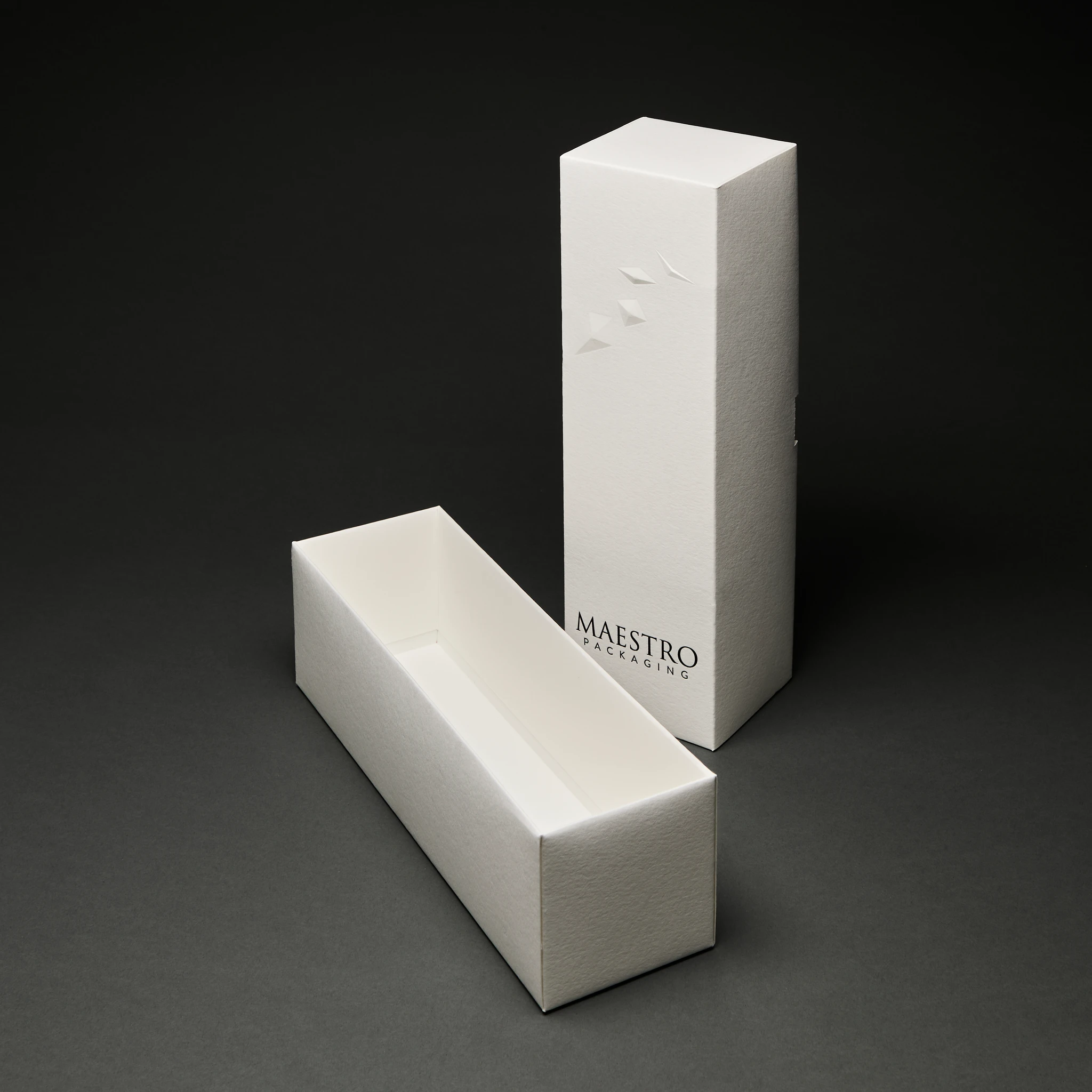
The white mock-up, made without printing or embellishment in the chosen cardboard, checks the actual volumes, the opening gestures, the resistance of the hinges or the holding of the magnets; it also evaluates the ergonomics (handling, extraction of the bottle or flask, shelf placement) and simulates palletizing and logistical constraints.
Engineering adjustments
At this stage, Maestro corrects the risks: games too tight or too loose, cardboard thicknesses incompatible with certain folding and gluing machines, embellishment areas too close to cuts and creases or the need for additional reinforcements on heavy formats such as high-end cognac boxes.
4. Prototype 3D printed and embellished packaging
From virtual model to material prototype
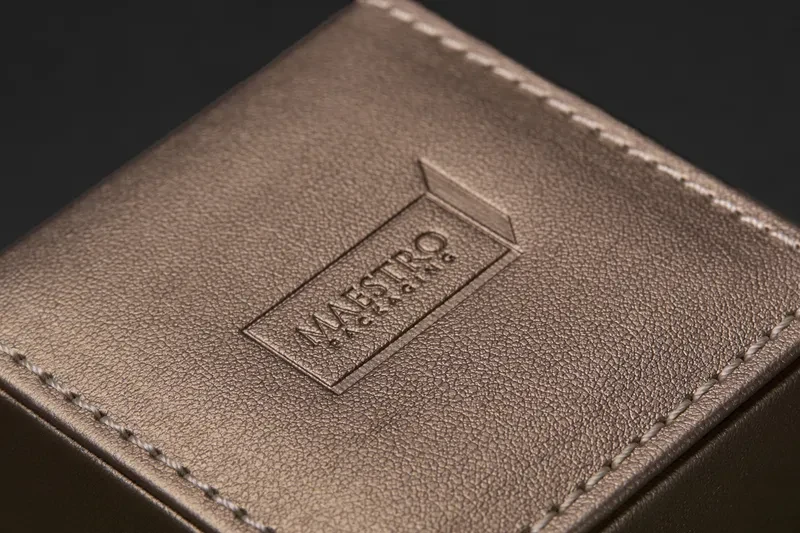
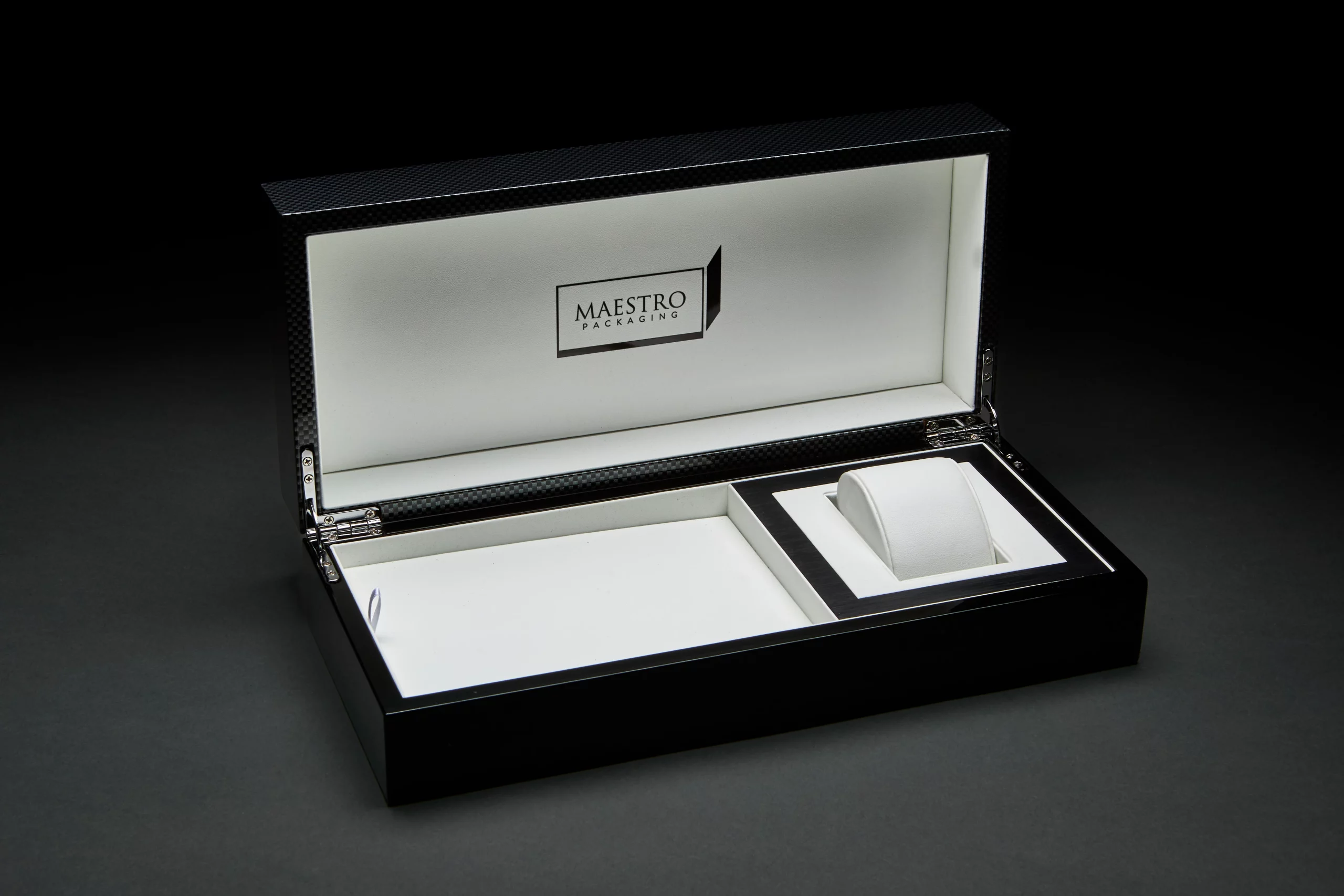
The printed prototype replicates the final design with four-color process or spot color printing, embellishments (hot or cold foil stamping, embossing, 3D spot varnish, foil, soft touch, textured lamination), custom internal inserts (laminated cardboard, high-density foam, mixed inserts), and, if necessary, connected elements such as an NFC tag or a security label. Maestro can also use resin 3D printing or CNC machining for complex parts.
Validation of colors and materials
The art directors oversee the accuracy of colors, the depth of gilding and embossing, as well as overall consistency with the brand platform and high-end publishing materials. Maestro's photogravure expertise aims for a perfect result on the first try, taking into account the constraints of papers, varnishes, and production equipment.
The table below summarizes the main types of luxury 3D packaging prototyping and their role in securing a launch.
| Project stage | Type of prototyping | Main objective | Associated deliverables |
|---|---|---|---|
| Framing and design | Virtual 3D model | Quickly arbitrate between creative directions and volumes | 3D mock-ups, high-definition renderings |
| Engineering and functional testing | White model | Validate structure, opening gestures and resistance | Functional model in the chosen cardboard, adjusted template |
| Creative and industrial validation | Printed and embellished prototype | Controlling colours, materials and finishes | Complete prototype close to production conditions |
| Pre-series and launch | Pre-production prototypes | Testing logistics, merchandising and real-world scenarios | Copies intended for testing, photo shoots, or targeted mailings |
5. Technical validation, pre-series and double production
Complete technical file
Maestro consolidates a comprehensive file including the final standardized files for printing, cutting and alignment plans, material sheets (cardboard, paper, inks, glues), specifications for embellishments and alignments as well as CSR requirements and certifications: FSC, vegetable-based inks, data for carbon footprint.
Pre-production run and fine adjustments
Depending on the volumes and criticality of the launch, a pre-production run allows for logistical testing, photo shoots or merchandising tests, and validation under real-world conditions. double production Supervised by Maestro, it aligns quality standards between Italy (artisanal know-how, proximity to European markets) and China (capacity, competitiveness) for a homogeneous result.
6. Transition to production and control of deadlines
Secure industrial planning
Based on the validated prototype, Maestro reserves machine slots, procures certified materials and tooling, and then synchronizes the flow between component manufacturing, enclosure assembly, potential filling, and final logistics. Having a factory presence in Italy and China allows them to anticipate and correct any deviations from the reference prototype.
Traceability and CSR reporting
Prototyping is only complete if it is accompanied by clear traceability: origin of materials and certifications, material and energy consumption data per batch, elements necessary for carbon footprint assessments, and extra-financial reports. This documentation, prepared from the earliest stages, prevents internal roadblocks when it comes to market launch.
FAQ
How is 3D luxury packaging prototyping different from a simple cardboard model?
Traditional model making allows visualization of a shape; luxury 3D packaging prototyping goes further by combining a photorealistic virtual 3D model, a functional white model, and an enhanced printed prototype. The goal is to test handling, durability, material rendering, and industrial reproducibility under conditions close to actual production.
How many prototype iterations should be planned for a high-end packaging design?
For a well-defined project, two to three iterations are sufficient: first, 3D models and white models to adjust the structure and volumes, then a printed prototype to refine colors and finishes. Maestro centralizes key decisions at each stage to minimize proofs and ensure deadlines are met.
Does 3D prototyping lengthen time to market?
When properly integrated into the planning process, 3D prototyping reduces time-to-market: it avoids costly setbacks once production has begun and allows for rapid iteration upstream. Virtual 3D models are obtained in a few days; white models and prototypes follow on a schedule compatible with demanding seasonal launches.
Can the prototype be used for photo shoots or press releases?
Yes. From the printed prototype phase, Maestro can produce a few specially calibrated copies for photography or press relations, in parallel with the preparation of the large series, without compromising the final quality.
Synthesis
In the luxury sector, moving from brief to prototype isn't about piling up models, but about following a method where each step prepares the next. Precise framing, paper engineering, white mock-up, luxury 3D packaging prototype, technical validation, and then supervised production across two continents form a continuous chain that secures even the most sensitive launches. By choosing a technical manufacturing office like Maestro, you base your creative ambitions on a partner capable of delivering reliable, traceable, and on-time industrial products. Explore the gallery of achievements from Maestro to discover other high-end box sets, catalogues and editions.