

Since its entry into force on February 10, 2020, the AGEC law (Law No. 2020-105 relating to the fight against waste and the circular economy) fundamentally reshapes the rules of the game for all players in the packaging sector, including luxury and premium cosmetic brands: the AGEC law premium packaging It is now becoming an essential framework. Long spared from the most stringent environmental regulations, high-end boxes, cases and packaging are now falling within the scope of specific obligations: reduction of plastics, recyclability, EPR for professional packaging, regulation of environmental claims.
For manufacturing directors, purchasing managers and brand managers of premium houses, the question is no longer whether compliance is necessary, but how to achieve it without sacrificing perceived value or falling into greenwashing.
AGEC Law on Premium Packaging | 2026 Guide
Reading time: ~10 min
- What the AGEC law actually changes for premium and luxury packaging
- The AGEC deadline schedule to know for packaging in 2025 and beyond
- Printing finishes and recyclability: what the AGEC law changes for high-end packaging
- How to design premium packaging that complies with the AGEC law without damaging the brand image
- Extended Producer Responsibility (EPR) for professional packaging: what are the obligations for B2B brands?
- How to avoid greenwashing on premium packaging while still highlighting your commitments
- AGEC compliance and packaging excellence: building together from the co-design stage
- FAQ
What the AGEC law actually changes for premium and luxury packaging
There The AGEC law rests on four fundamental pillars Eliminating single-use plastics, better informing consumers, fighting waste, and developing reuse are key objectives. For premium brands, these four areas translate into concrete constraints that affect packaging design, material composition, and the messaging that accompanies it.

Single-use plastics and premium packaging
The first impact concerns the single-use plastics. The law provides for their gradual phase-out on the French market by 2040, with bans by category staggered throughout the decade. Plastic films, unnecessary over-packaging, and decorative accessories made of non-recyclable plastic are directly targeted. For a perfume box or cosmetics case incorporating heat-shrink film or plastic padding, compliance is no longer optional.
Reuse objectives in the luxury sector
The second impact concerns the reuse. The law sets specific targets for France: 5 % of packaging placed on the market in reusable mode in 2023, and 10 % in 2027. These targets, although still little applied in the luxury sector, open the way to new formats of boxes designed to be kept, refilled or returned — a logic already explored by some niche perfume houses.
Reporting obligations of producers
The third impact concerns the reporting obligations of producers. Any producer or importer placing packaging on the French market is subject to obligations regarding declarations, contributions to an Extended Producer Responsibility (EPR) scheme, and environmental labeling. Ignoring these obligations exposes brands to administrative penalties and increasing reputational risk.
The AGEC deadline schedule to know for packaging in 2025 and beyond
Achieving compliance is not a one-step process. Deadlines are spread over several years and concern distinct packaging categories. Here are the key regulatory milestones for stakeholders in the premium packaging.
| Due date | Main obligation | Impact for premium packaging |
|---|---|---|
| 2023 | Target of 5,13T of reusable packaging | Incentives to design durable and refillable boxes |
| 2024 | Gradual implementation of Extended Producer Responsibility (EPR) for Industrial and Commercial Packaging (EIC) | Obligation to make a financial contribution for B2B packaging |
| 2025 | Strengthening of recyclability requirements (CITEO index) and regulation of environmental claims (Decree No. 2022-748) | Revision of the finishes and wording on the packaging |
| 2027 | Target of 10,13T of reusable packaging | Acceleration of reusable formats in luxury |
| 2040 | End of marketing of single-use plastic packaging | Complete transition to alternative materials for all formats |
This timeline necessitates medium-term planning. Brands that wait until the last minute to act risk prototyping and supplier qualification delays that are incompatible with their launch cycles.
Good to know The 3R Decree (reduction, reuse, recyclability), published pursuant to the AGEC law, sets quantified targets for each lever. It serves as the technical reference for assessing packaging conformity, complementing the CITEO standards for recyclability.
Printing finishes and recyclability: what the AGEC law changes for high-end packaging
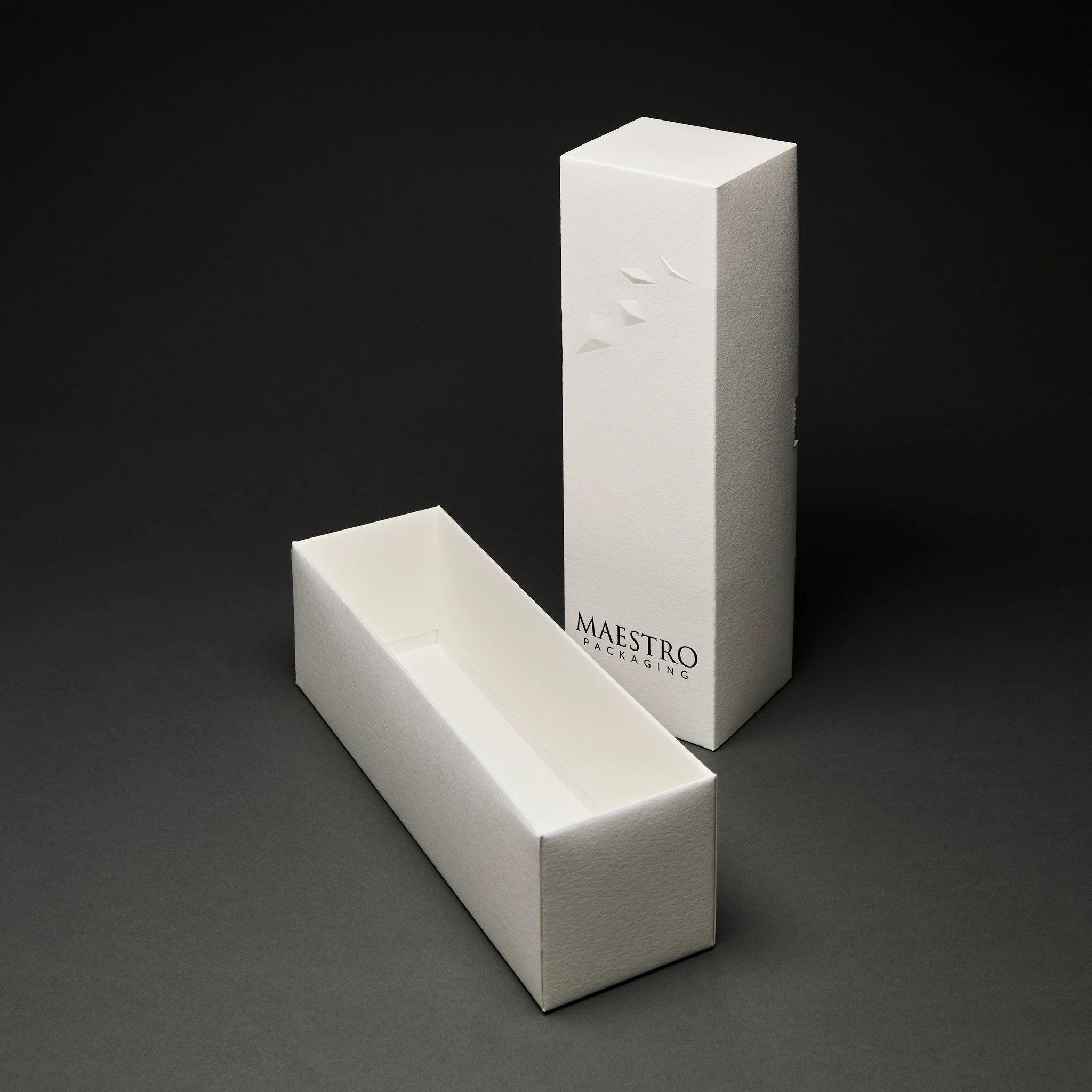
It is on this point that the AGEC law produces its most concrete effects in the premium printing sector. The finishes that constitute the visual and tactile signature of luxury packaging — matte or glossy lamination, hot foil stamping, embossing, debossing, 3D selective UV varnish — are not all equivalent from the point of view of recyclability.
Finishes that pose a risk from a recyclability perspective
CITEO, the approved eco-organization for the Extended Producer Responsibility (EPR) scheme for household packaging, has developed a recyclability assessment framework that assigns a bonus or penalty to each package based on its composition and finishes. The main recycling disruptors identified are: plastic films that cannot be separated from the cardboard during recycling, large quantities of mineral inks, multi-component adhesives, and complex multi-material structures where cardboard, plastic, and metal are inseparable.
Finishes compatible with a good recyclability index
However, several finishes remain compatible with a good recyclability index, provided they are correctly formulated and applied:
- There hot gilding Uncoated cardboard may be compatible if it represents a limited surface area.
- THE aqueous varnish are generally less disruptive than UV-cured varnishes.
- THE embossing and debossing, which do not add foreign material, do not affect the recyclability of the cardboard.
- THE bio-based inks and water-based adhesives improve the overall environmental profile of the packaging.
The key lies in integrated design: choosing finishes based on their impact on recyclability from the co-design phase, not after the graphic design has been finalized. This is precisely what a technical manufacturing office approach allows, where paper engineering and mastery of the graphic chain are mobilized from the initial creative brief.
How to design premium packaging that complies with the AGEC law without damaging the brand image
Regulatory constraints can become a creative lever if integrated early in the process. Eco-designing high-end packaging doesn't mean sacrificing material excellence or sophisticated finishes. It means choosing the right materials, in the right proportions, using the right techniques.

Choose premium materials that comply with the AGEC law
Cardboard is currently the best-positioned material to simultaneously meet AGEC requirements and luxury aesthetic standards. Compact packaging, made from FSC-certified cardboard, offset printed with bio-based inks, embossed or debossed without plastic lamination, can achieve an excellent recyclability rate while offering a premium tactile and visual experience.’recyclable cardboard packaging represents a concrete response to the AGEC obligations of brands, provided that the structure is designed to avoid non-separable multi-material assemblies.
Reducing over-packaging without losing perceived value
Reducing over-packaging is another key lever. The AGEC law explicitly targets secondary packaging that is not essential for product protection. For a cosmetics or spirits brand, this means reviewing the relevance of each layer of packaging and optimizing the structure to serve protection, the opening experience, and regulatory compliance simultaneously.
Prototyping and technical validation of packaging
Packaging prototyping plays a crucial role here. Physically testing packaging before launching production allows us to validate the recyclability of the finishes, its mechanical resistance without excessive over-packaging, and the consistency between the creative intent and the material result. At Maestro, this prototyping phase is integrated into the manufacturing process, with technical control carried out as close as possible to the production workshops, in Italy or China depending on the project.
Key points to remember Premium packaging that complies with the AGEC law is not inferior packaging. It is packaging where every choice of material and finish has been carefully considered from the co-design phase, with a partner capable of simultaneously assessing perceived value and recyclability.
Extended Producer Responsibility (EPR) for professional packaging: what are the obligations for B2B brands?
There Extended Producer Responsibility (EPR) scheme for Industrial and Commercial Packaging (EIC) is one of the most significant extensions of the AGEC law for B2B players in premium packaging. It concerns primary, secondary and tertiary packaging used to market products consumed or used by professionals — a definition that encompasses a large part of the boxes and packaging produced for luxury houses, art publishers and spirits brands.
Any producer subject to this Extended Producer Responsibility (EPR) scheme must register with an approved eco-organization, declare annually the tonnages of packaging placed on the market, and contribute financially to the collection and recycling sector. The lack of transparency in subcontracting poses a real risk: if material traceability is not documented from beginning to end, the EPR declaration cannot be reliable, exposing the producer to the risk of non-compliance during an audit.
For purchasing managers in luxury groups subject to CSR roadmaps imposed by their management, this traceability requirement is becoming a supplier selection criterion. A manufacturing partner capable of providing complete documentation on packaging composition, material certifications, and production flows represents a decisive advantage in a tender process. Discover how our dual production device guarantees this traceability at every stage.
How to avoid greenwashing on premium packaging while still highlighting your commitments
THE Decree No. 2022-748 relating to consumer information on the qualities and environmental characteristics of products The law strictly regulates environmental claims that can appear on packaging. Generic formulations such as "eco-friendly packaging," "green packaging," or "environmentally friendly" are now considered misleading if they are not supported by precise and verifiable data.
For a premium brand, the risk of greenwashing is twofold: reputational and legal. The solution is not to abandon communication about environmental commitments, but to document them precisely. Packaging can legitimately mention its FSC certification, its percentage of recycled materials, its recyclability verified according to the CITEO standard, or its bio-based ink, provided that this information is accurate, measurable, and auditable.
ADEME and the Ministry for Ecological Transition have published practical guides on environmental labeling that enable brands to structure their communication in a compliant manner. The support of a manufacturing partner with end-to-end material traceability is essential for producing reliable and usable documentation for both communication materials and supplier qualification files.
At Maestro, complete control of the graphic chain and physical supervision of production allow us to document every step of the process—from raw materials to finishing touches—and provide brands with the elements necessary for rigorous environmental communication. This approach directly addresses the expectations of purchasing managers and brand managers who must justify their choices to their finance department and CSR teams. To learn more, see our page dedicated to packaging Or get in touch with our team.
AGEC compliance and packaging excellence: building together from the co-design stage
The AGEC law does not spell the end of premium packaging. It redefines the rules of design, production, and communication. Brands that anticipate these obligations—by integrating eco-design from the creative brief, choosing finishes compatible with recyclability, and rigorously documenting their material traceability—transform a regulatory constraint into a competitive advantage.
Those who wait until the last minute to act risk compliance delays incompatible with their launch cycles and an increasing reputational risk. AGEC compliance and excellence in premium packaging are not mutually exclusive: they are built together, starting from the very first co-design meeting.
FAQ
Does the AGEC law prohibit luxury finishes such as hot foil stamping or embossing?
No, the AGEC law does not prohibit these finishes as such. It requires that packaging be recyclable or reusable. Hot foil stamping and embossing can be compatible with a good CITEO recyclability rating if the treated surface area is limited and if the packaging does not contain a non-separable plastic film. It is the combination of finishes and the overall structure of the packaging that determines its compliance.
What is Extended Producer Responsibility (EPR) for Industrial and Commercial Packaging and who is affected?
The EPR EIC scheme is an extended producer responsibility scheme that applies to packaging used to market products to professionals. Any producer placing primary, secondary, or tertiary packaging on the French market in a B2B context is potentially affected and must register, declare their tonnages, and contribute financially to the scheme.
Is plastic lamination prohibited on premium packaging?
Plastic lamination is not formally prohibited by the AGEC law, but it constitutes a major recycling impediment according to the CITEO standard, resulting in a financial penalty under the Extended Producer Responsibility (EPR) scheme. Laminations that cannot be separated from the cardboard during recycling significantly reduce the packaging's recyclability index. Alternatives exist, such as water-based varnishes or separable bio-based laminations, which maintain a premium finish while improving the environmental profile.
How to prove the environmental compliance of premium packaging during a tender process?
Proof of conformity relies on several documents: FSC or PEFC certification of the cardboard used, the technical data sheet for the inks (bio-based or compliant with regulatory thresholds), the recyclability assessment according to the CITEO standard, and the declaration of contribution to the relevant Extended Producer Responsibility (EPR) scheme. A manufacturing partner capable of providing these turnkey elements significantly simplifies the preparation of a supplier qualification file.
Can plastic still be used in a premium gift box after the AGEC law?
The use of plastic is not completely prohibited, but it is being progressively restricted for single-use plastics. Non-recyclable plastic packaging, films, and accessories are the first to be targeted. Structures incorporating recyclable or recycled plastic and clearly marked for sorting may still be used, but they must be assessed against the recyclability criteria and reduction targets set by Decree 3R.
What is the difference between primary, secondary and tertiary packaging as defined by the AGEC law?
Primary packaging is in direct contact with the product (bottle, tube, jar). Secondary packaging groups several units or protects the primary packaging (carton, box, carton). Tertiary packaging is used for transport and logistics (shipping carton, pallet). The AGEC law and the EPR EIC apply to these three levels, with obligations that vary depending on the intended use of the packaging (household or professional) and the status of the producer.