
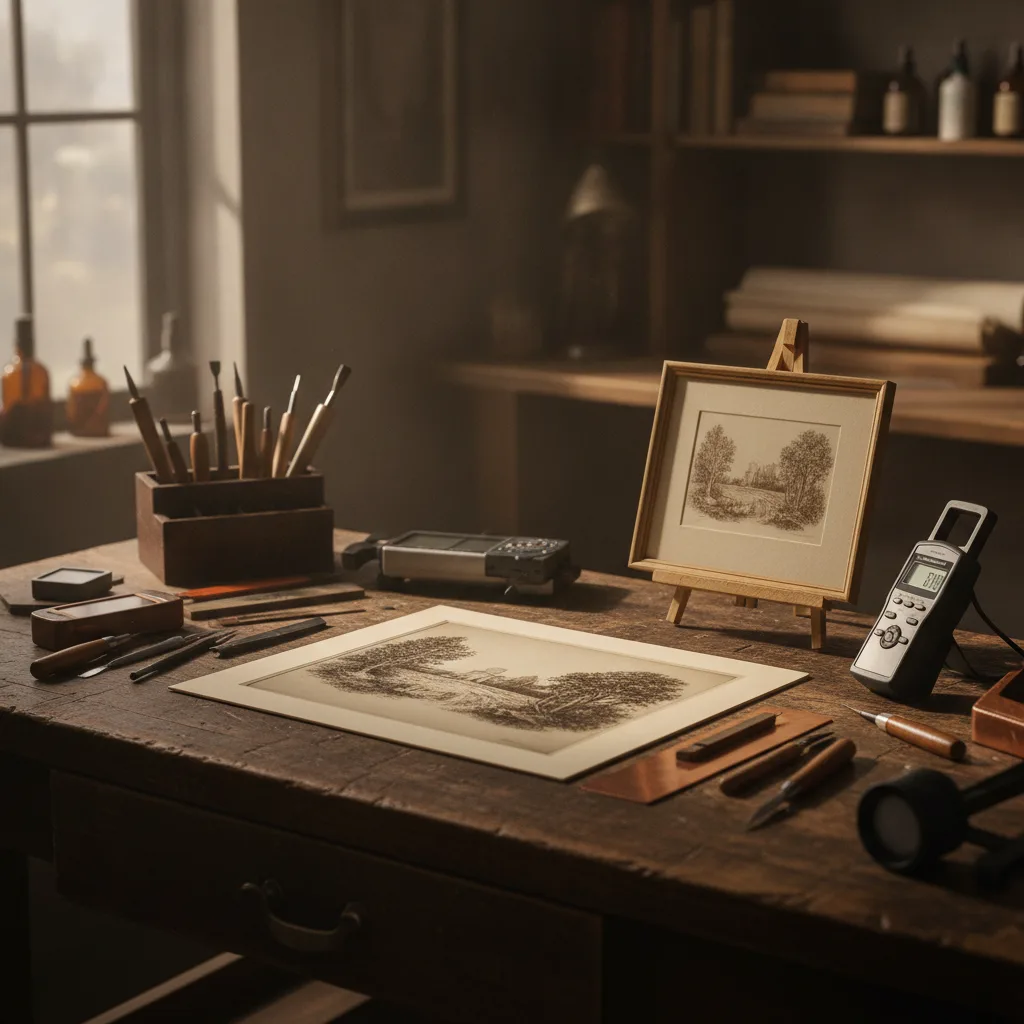
Reproducing a work of art on paper means accepting a contract of absolute fidelity to the original. Photogravure, the direct descendant of heliogravure and intaglio printing, remains the gold standard for achieving this requirement. However, in the field of photogravure and art reproduction, each step between the initial digitization and the final print contains technical pitfalls that only a trained eye can anticipate. This article details the complete process of photogravure applied to the reproduction of artworks, the common errors that compromise the result, and the quality standards expected by museums, artists, and art publishers in 2026.
Photogravure is a photomechanical process that lies at the intersection of photography and intaglio printing. Its principle is based on transferring a photographic image onto a copper plate, which is then etched chemically, inked, and printed onto paper. Unlike halftone processes such as halftone printing, it produces very fine, continuous tones without any screen visible to the naked eye. This ability to reproduce subtle gradations of gray and exceptional depth of black makes it a preferred choice for fine art prints, photographers' portfolios, and high-end exhibition catalogs.
Historically, photogravure solved a fundamental problem for the art world as early as the 1880s: how to disseminate paintings, drawings, and photographs in printed form without betraying the nuances of the original. Alfred Stieglitz, among others, used this process to publish photographic prints whose tonal richness rivaled that of silver gelatin prints. Even today, the unique texture of intaglio printing, its characteristic grain, and the very substance of the ink give each reproduction the status of a fine art print rather than a mere industrial copy.
Photogravure and reproduction of works of art: the requirement of fidelity that separates the craftsman from the industrialist
Reading time: ~8 min
- What is photogravure in the context of artistic reproduction?
- The key steps in photogravure for reproducing a work of art
- Common errors that compromise reproduction fidelity
- Photogravure, offset printing and digital printing: which process for which use?
- The quality standards expected by museums and artists
- FAQ
- Expertise that goes beyond just a machine
What is photogravure in the context of artistic reproduction?
Photogravure is a photomechanical process that lies at the intersection of photography and intaglio printing. Its principle is based on transferring a photographic image onto a copper plate, which is then etched chemically, inked, and printed onto paper. Unlike halftone processes such as halftone printing, it produces very fine, continuous tones without any screen visible to the naked eye. This ability to reproduce subtle gradations of gray and exceptional depth of black makes it a preferred choice for fine art prints, photographers' portfolios, and high-end exhibition catalogs.
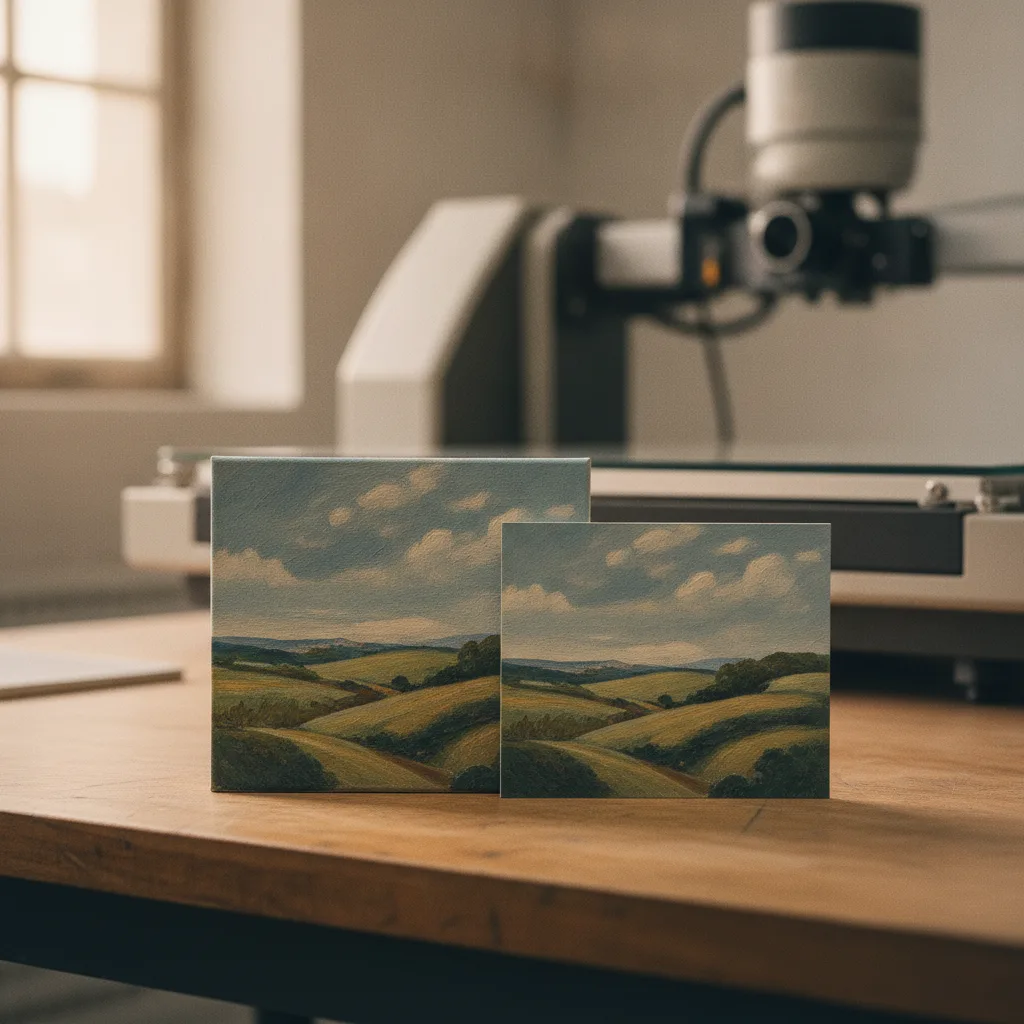
Historically, photogravure solved a fundamental problem for the art world as early as the 1880s: how to disseminate paintings, drawings, and photographs in printed form without betraying the nuances of the original. Alfred Stieglitz, among others, used this process to publish photographic prints whose tonal richness rivaled that of silver gelatin prints. Even today, the unique texture of intaglio printing, its characteristic grain, and the very substance of the ink give each reproduction the status of a fine art print rather than a mere industrial copy.
The key steps in photogravure for reproducing a work of art
High-resolution scanning and file preparation
It all begins with capturing the original artwork. Whether it's an oil painting, a charcoal drawing, or a photograph, the digitization must be done in very high definition (generally a minimum of 600 dpi for a full-size print). The choice of lighting during the shoot is crucial: poorly calibrated lighting flattens the textures of a canvas or distorts the color values. The resulting file is then converted to grayscale for monochrome prints, or processed using four-color process printing for color reproductions, with particular attention paid to contrast and tonal dynamics.
Creation of the ICC profile and contractual assessment
The ICC (International Color Consortium) profile is the cornerstone of color fidelity. It translates the characteristics of the ink and paper combination chosen for printing, ensuring that the colors displayed on screen correspond to those that will be printed. The contract proof (or "cromalin") is then produced: this is a reference print, approved by the artist or curator, which will serve as the standard throughout the production process. Without this step, the color drift between the digital file and the final print can reach discrepancies unacceptable for museum use.
Delta E calibration and quality control in production
Delta E measures the perceptible difference between two colors. In art reproduction, the most demanding standards require a Delta E of less than 2 (the threshold below which the human eye can no longer distinguish between the contract proof and the print). Each printed sheet is compared to the reference proof using a spectrophotometer. This calibration is not a one-time adjustment: it must be maintained throughout the printing process, which requires constant monitoring of ink density, pressure, and paper moisture content.
Engraving of the plate and printing on the press
In the traditional photogravure process, the copper plate is grained (by aquatint), coated with photosensitive gelatin, and then exposed under a positive film to UV light. The exposed areas harden while the protected areas remain soluble. After hot water development, the plate is immersed in several baths of ferric chloride at decreasing concentrations. The areas corresponding to black are etched deeply, the intermediate grays less so, and the whites remain intact. The plate is then inked, wiped (the ink remains only in the recesses), and printed onto damp paper using an intaglio press.
Common errors that compromise reproduction fidelity
Several pitfalls regularly recur in projects to reproduce works of art, even among experienced service providers.
Neglect of initial digitization
The first pitfall is neglecting the initial digitization process. An underexposed or overcompressed file can never be "recovered" later: the information lost in the highlights or deep shadows is permanently gone. The second trap concerns the absence of an ICC profile dedicated to the final substrate. Using a generic profile for a specific paper (for example, a heavyweight, pure cotton vellum) produces systematic color shifts. The third, more insidious problem is the lack of monitoring during the printing process. In a run of 500 copies, the ink density can vary if the workshop temperature fluctuates or if the ink thickens in the inkwell. Without regular spectrophotometric monitoring, the final prints will differ significantly from the first.
Paper selection for photogravure
Finally, an often underestimated point concerns the choice of paper. Paper engineering plays a role as crucial as the quality of the engraving itself. Paper that is too absorbent "drinks up" the ink and flattens the contrasts. Paper that is too smooth can produce a cold rendering, disconnected from the texture of the original artwork. Finding the right balance between weight, texture, whiteness, and absorbency is a skill in itself.
Photogravure, offset printing and digital printing: which process for which use?
Comparison of methods for reproducing works of art
| Criteria | Photogravure (heliogravure) | High-end offset | Digital printing (giclée) |
|---|---|---|---|
| Rendering of continuous tones | Exceptional, with no visible pattern | Very good with fine grain (AM/FM) | Okay, but the pattern is noticeable when enlarged. |
| Depth of blacks | Maximum (ink in the recesses) | Raised with careful support | Variable depending on the pigment inks |
| Unit cost in small batches | Elevated (plate preparation) | Medium to high (machine setup) | Low profile (no printing form) |
| Suitable for major series | No (limited print run due to plate wear) | Yes | No (constant unit cost) |
| Perceived value (print status) | Very high | Average | Medium to low |
| Durability of the print | Excellent (intaglio inks) | Very good (offset inks) | Variable (UV sensitivity depending on inks) |
For a photo exhibition catalog or a limited-edition artist's book, photogravure remains unsurpassed in terms of quality and prestige. For larger print runs (1,000 copies and above), high-end offset printing, controlled with the same meticulous Delta E calibration and ICC profile, offers a remarkable balance between fidelity and volume. It is precisely in this mastery of the process, regardless of the method chosen, that the value of a truly technical production office lies.
The quality standards expected by museums and artists
Technical requirements of museums and artists
Museums and contemporary artists impose precise specifications for any reproduction of their works. The contractual Delta E is generally set below 2, sometimes below 1.5 for prestige prints. The paper must be certified acid-free to guarantee preservation for several decades. The inks used must be lightfast (UV resistance test according to ISO standards). Each print is numbered, accompanied by a certificate of authenticity, and the colophon systematically mentions the technique used ("photogravure after…" or "offset reproduction after…").
Legal framework for the reproduction of works of art
From a legal standpoint, reproducing a protected work requires the authorization of the rights holder (artist, heirs, or holding institution). The distinction between an original work and a reproduction print is fundamental: a photogravure made from a masterpiece painting is not an original work by the artist, but a reproduction print whose value lies in the quality of the process and its fidelity to the original.
FAQ
What is the difference between photogravure and heliogravure?
Both terms refer to the same photomechanical process of reproduction on copper plates engraved using the intaglio technique. "Heliogravure" is the historical French term (from the Greek helios, (sun, in reference to light exposure), while "photogravure" has become the common term in the vocabulary of printing and art publishing. In both cases, the principle is identical: photographic transfer onto gelatin, acid etching, inking of the recesses, and printing on a press.
How to guarantee the colorimetric fidelity of a reproduction of a work of art
Fidelity rests on three inseparable pillars: high-resolution scanning carried out under controlled lighting conditions, an ICC profile specific to the ink and paper combination of the final print, and continuous spectrophotometric monitoring during production (Delta E calibration less than 2). The contract proof, validated by the artist or curator, serves as the absolute reference throughout the entire process.
Is photogravure suitable for serial exhibition catalogues?
For limited print runs (a few dozen to a few hundred copies), traditional photogravure offers unparalleled results. For larger runs, a high-end offset printing process, managed with the same professional photogravure standards (dedicated ICC profile, contract proof, Delta E control), makes it possible to reconcile reproduction fidelity with production volume.
Expertise that goes beyond just a machine
The faithful reproduction of a work of art, whether achieved through traditional photogravure or high-precision offset printing, is first and foremost a matter of human skill. Each step, from digitization to final registration, demands technical judgment that only a trained operator physically present in production can exercise. It is this philosophy of the technical production office, capable of overseeing each phase of the process and guaranteeing a result that meets the expectations of museums and publishing houses, that we champion at Maestro. To discover how this requirement is reflected in our editorial projects, we invite you to Explore our high-end publishing achievements.