
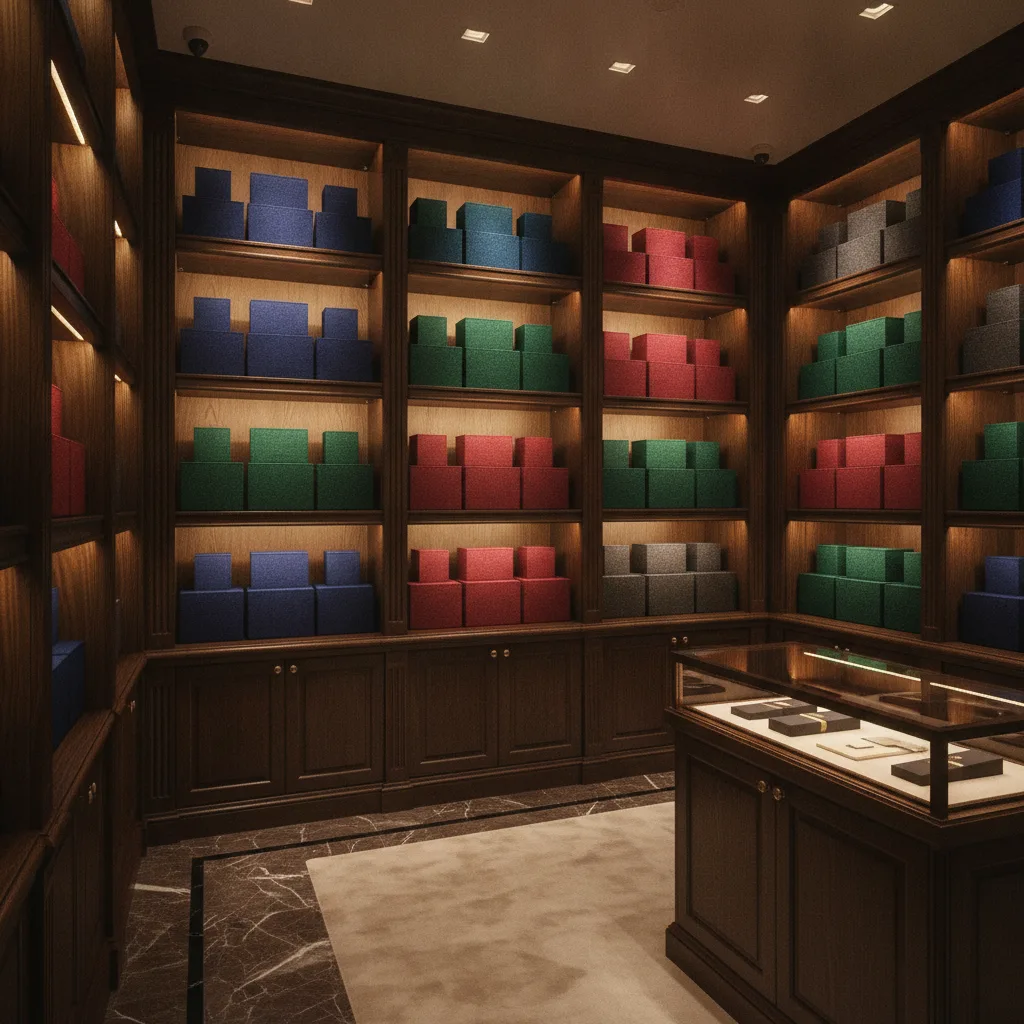
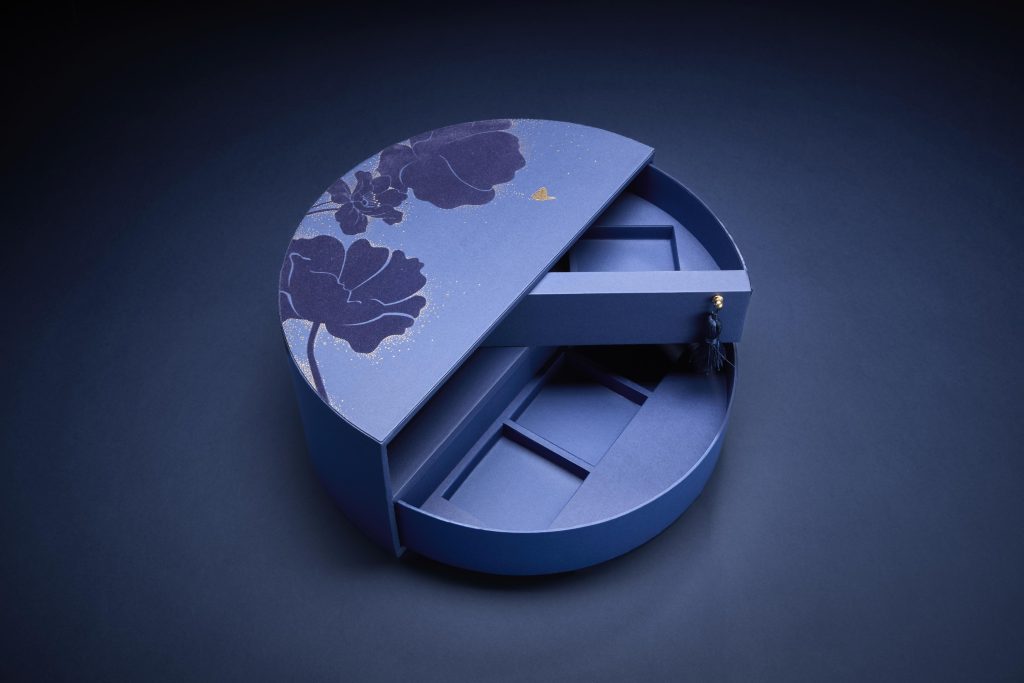
In a world where shelves overflow with impeccably printed boxes and cases, it's often the first tactile contact that makes all the difference. Soft-touch lamination for luxury packaging has become one of the most powerful tools for creating that immediate impression of refinement sought by perfume, spirits, and cosmetics brands. Beyond its velvety matte appearance, it transforms a box into a truly tactile object, extending the brand experience long after it's opened.
But not all applications are created equal: compatibility with hot foil stamping, spot varnishing, scratch resistance, CSR requirements… this choice must be considered from the initial briefing. This is precisely where the technical manufacturing office comes in. Maestro intervenes by integrating touch as a fully-fledged engineering parameter and not as a simple decorative finish at the end of the chain.
Soft-touch lamination in luxury packaging: why touch has become the secret weapon of high-end packaging
Reading time: ~13 min
- What is soft-touch lamination in luxury packaging?
- Why touch has become strategic in high-end packaging
- The tangible benefits of soft-touch lamination for luxury
- Soft touch, matte, glossy: how to choose the right finish
- Soft touch versions, scratch and smudge resistant
- Soft touch technology is compatible with gold foil stamping and spot varnishing.
- Limitations, technical constraints and points of vigilance
- How Maestro incorporates touch from the briefing stage
- FAQ
What is soft-touch lamination in luxury packaging?
Lamination is a finishing technique that involves applying a very thin film to a printed item to protect it and enhance its visual appeal. Soft touch is a specific variation designed for high-end products.
In practical terms, it offers two complementary effects: an extra-matte finish that reduces glare and gives visual depth to solid colors, and a velvety feel often described as "peach skin." This dual visual and tactile dimension makes it a natural choice for rigid boxes, niche perfume cases, limited-edition spirits, or art catalogs. Where a classic matte lamination simply controls glare, soft touch immediately evokes an image of softness, sophistication, and superior perceived value.
At Maestro, this finish is approached as a structuring element of the art direction and paper engineering, not as a simple option ticked at the end of the quote.
Why touch has become strategic in high-end packaging
In the luxury sector, the battle is no longer fought solely on visual appeal. Buyers handle, compare, and weigh products; the slightest difference in texture can be enough to convey a difference in quality. Soft-touch lamination addresses this evolution in three ways.
It first creates a global sensory experience: the eye perceives a deep matte finish, the hand discovers a warm and soft surface that contrasts with the surrounding glass, metal or cellophane, generating a micro-moment of surprise followed by the desire to prolong the contact.
It then reinforces consistency with brand positioning. A niche perfume, a premium cognac vintage or a high-performance cream cannot afford a case with a banal feel; the soft touch acts as a physical extension of the brand message (rare quality, extreme care, closeness to the skin).
Finally, it fosters attachment to the object: a box that is kept in a library, a press kit that is not thrown away, a catalogue that is leafed through again… The velvety touch encourages preservation and fuels memorization and desirability.
The tangible benefits of soft-touch lamination for luxury
Controlled protection and durability
Like all laminations, the soft-touch version protects the substrate from everyday wear and tear. It improves resistance to moisture, friction, dirt, and tearing; essential for boxes handled in stores and then by the end customer. Corners are less damaged, colors fade more slowly, and the cardboard shows less wear from impacts.
Premium aesthetic finish
Visually, the soft touch finish is similar to classic matte but with increased depth and uniformity. On dark shades, it eliminates unwanted shine while enhancing color intensity. Applied to a jewelry box, it will highlight hot foil stamping without any unwanted reflections; on cosmetic packaging, it creates a subtle contrast with selectively varnished areas.
A distinctive sensory experience
The slightly warm, non-slip texture creates a feeling of control over the object; in a premium purchase, this detail reflects the extreme care taken by the brand. For an art direction, it's a way to increase emotional depth without visual overload; for a young brand, a powerful shortcut to the standards of major fashion houses.
Soft touch, matte, glossy: how to choose the right finish
Glossy film coating
It accentuates colors, enhances contrasts, and produces a mirror effect that's ideal for highly saturated visuals or pop art aesthetics. However, it can appear less refined in a discreetly luxurious setting and emphasize the reflections of light on shelves.
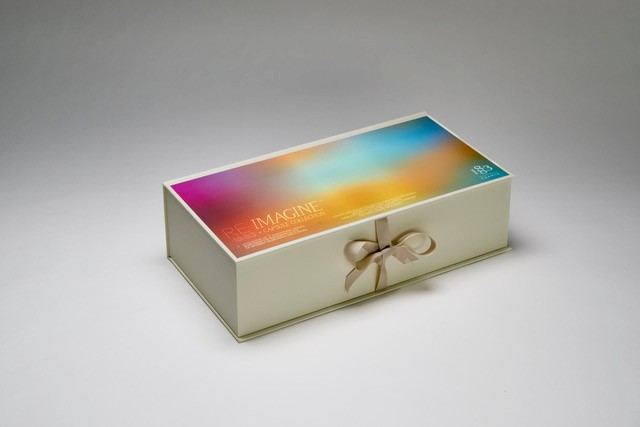
Classic matte lamination
It reduces reflections while protecting the support and conveys a sobriety appreciated on institutional documents, but remains neutral to the touch; sometimes insufficient for a very premium box.
Soft touch film coating
It combines masterful use of reflections with a pronounced tactile dimension: it enhances a clean, minimalist artistic direction, offers a sharp contrast with selectively varnished, glossy, or 3D areas, and reinforces the impression of meticulous attention to detail. At Maestro, this choice is systematically correlated with the type of cardboard, the closure method, logistical constraints, and the overall finishing plan.
| Finishing | Visual appearance | To touch | Recommended usage contexts |
|---|---|---|---|
| Glossy film coating | Accented colours, reinforced contrasts, pronounced mirror effect. | No specific tactile dimension is emphasized; the focus is on shine. | Highly saturated visuals, pop universe, packaging seeking a strong mirror effect. |
| Classic matte lamination | Reduced reflections, protection of the surface, understated finish. | Neutral to the touch, without a velvety effect. | Institutional documents and packaging where simplicity is key. |
| Soft touch film coating | Deep and even matte finish, ideal for clean artistic directions and contrast with selective varnishing. | Velvety feel, often described as a "peach skin", marked tactile dimension. | Rigid boxes, niche perfume cases, limited editions of spirits, art catalogues and high-end luxury packaging. |
Soft touch versions, scratch and smudge resistant
The classic soft-touch finish can be susceptible to fingerprints and micro-scratches, especially on dark surfaces. For a luxury launch, this requires careful planning. Two main alternatives exist:
- Soft touch anti-scratch: reinforced formulation limiting markings during handling, ideal for boxes that are heavily used before arriving in stores.
- Soft touch anti-fingerprint: better resistance to fingerprints, recommended for black or very dark shades and packaging tested directly by the customer.
These variants often require a slight additional cost and precise machine settings; the presence of Maestro technicians in Italy and China allows the correct film/substrate combinations to be validated from the first tests.
Soft touch technology is compatible with gold foil stamping and spot varnishing.
Hot foil stamping on soft touch
Perfectly compatible provided that temperature and pressure are adjusted to penetrate the film without burning it, a suitable laminating film is chosen and preliminary tests are carried out, particularly on large gilded surfaces or very fine lines.
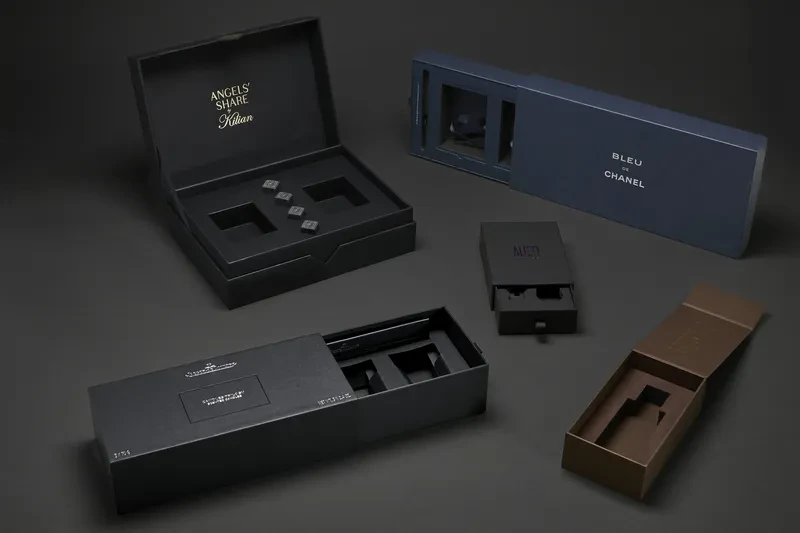
Selective varnishing (glossy or 3D)
Selective varnishing on soft-touch surfaces allows for localized gloss: on a perfume box, the background remains velvety while the fragrance name stands out in gloss or subtle 3D relief. Proper varnish adhesion to the film and layer thickness must be verified on a case-by-case basis.
Limitations, technical constraints and points of vigilance
Sensitivity to marks and dark colors
Deep blacks or midnight blues can show more marks; using recent generation films, testing on final colors and adjusting the ink coverage limits this risk.
Media compatibility and paper weights
Lamination is recommended for materials heavier than approximately 250 gsm or for laminated cardboard; on thinner materials, the finish ages less well and creases more easily. Maestro always approves all aspects: paper weight, structure, film type, folding, gluing, and logistics.
Industrial process and deadlines
Depending on volumes, finishes, and distribution areas, the soft touch can affect certain manufacturing times (drying, positioning, quality control). A dual production system in Italy and China, managed by Maestro, streamlines the supply chain while maintaining the same high standards of tactile and visual quality.
How Maestro incorporates touch from the briefing stage
At Maestro, touch is never an afterthought; it's integrated from the very beginning of the design process. The sensory intent is challenged during the briefing phase, just as much as the art direction. Paper and film choices are made to support this intent, and prototypes are physically validated at the factory with Maestro technicians on hand to fine-tune the settings. Both the supply chain and CSR (Corporate Social Responsibility) are documented (films compatible with environmental objectives, traceability, FSC certifications, production reports). The result: less risk of technical incompatibilities during production, mock-ups that faithfully reflect the tactile and chromatic sensibility of the design, and a well-documented message about the added value of the finishing process for marketing and purchasing departments.
FAQ
Is soft-touch lamination still suitable for luxury packaging?
It is particularly relevant for most premium sectors (perfume, cosmetics, spirits, publishing, jewelry) where an elegant matte finish and a velvety feel are desired. It will be less suitable for a very high-tech brand or one aiming for a pronounced mirror effect, where a glossy finish or a targeted matte/glossy mix may be more effective.
Soft touch or soft touch varnish: what's the difference?
Soft-touch lamination is a very thin plastic film applied after printing; it offers strong mechanical protection and a smooth, even feel. Soft-touch varnish is a varnish layer that mimics this effect but provides less protection. For a luxury box designed to last, Maestro favors this film or a combination of both, carefully selected according to the specific requirements.
Is soft touch lamination compatible with an eco-responsible approach?
Soft touch film remains a plastic film and therefore raises CSR (Corporate Social Responsibility) questions. More easily recyclable or partially bio-based films exist, provided the graphic and logistics chain is controlled. Maestro integrates these parameters from the initial selection of FSC-certified papers, films, and the logistics plan, and provides the necessary documentation for Green Premium reporting and tenders.
Soft-touch lamination is now one of the key finishes for giving high-end packaging that tactile signature that customers expect, even if they don't always articulate it. When correctly chosen, combined, and industrially mastered, it becomes a true differentiating tool for your niche perfume sets, limited-edition spirits, or premium press kits. To discover Maestro's approach and achievements, visit [website address]. maestro-manufacture.com.