
Entrusting the manufacture of a luxury packaging And the quality control of luxury packaging in a Chinese factory still raises a legitimate concern among many production managers and brand managers. Distance, language, cultural differences in production, and the fear of a final product that betrays the creative intent are real obstacles. Yet, China now boasts some of the world's most advanced equipment for rigid boxes, hot foil stamping, and premium finishes.
The question, therefore, is not "Can luxury goods be produced in China?" but "How can this be guaranteed?" It is precisely around this answer that Maestro has built its quality control system for luxury packaging in China, deploying its own technicians on-site, imposing standards identical to those applied in Italy, and documenting each step for its clients.
Luxury Packaging Quality Control in China | Maestro
Reading time: ~8 min

- Summary in brief
- Why China remains essential for luxury packaging
- The specific challenges of luxury printed packaging in China
- The quality control system for luxury packaging in China deployed by Maestro
- Standards and certifications to require from a premium packaging manufacturer in China
- Operational checklist: priority control points before shipment
- The hybrid Europe-China supply chain: how Maestro combines Italian and Chinese production
- Quality is not a matter of geography, it's a matter of method
- FAQ
Summary in brief
Why China is essential for premium packaging: cutting-edge industrial capabilities, competitiveness in large series, but reinforced control requirements.
The specific challenges of the luxury sector: Colour stability, consistency of finishes, REACH regulatory compliance and material traceability.
The Maestro system is in place: resident technicians, shared Pantone recipes, ongoing audits and a three-phase validation protocol.
The standards to be required: ISO 9001, FSC, AQL, and third-party SGS or Bureau Veritas audits.
The operational checklist: Priority checkpoints before shipment for premium packaging.
The Europe-China hybrid chain according to Maestro: how to combine Italian and Chinese production without compromising on perceived quality.
Why China remains essential for luxury packaging, and why this requires increased rigor.
The global luxury packaging market relies heavily on Chinese production for rigid boxes, gift sets, and premium cosmetic packaging. Specialized manufacturers in the Shenzhen, Shanghai, and Guangzhou regions have production lines capable of performing hot foil stamping, embossing, 3D spot varnishing, and laser cutting with a precision that few European factories can match on large production runs. For a luxury brand or art publisher, ignoring this industrial reality means missing out on a significant competitive advantage.
But this competitiveness comes at a price: without a physical presence and a rigorous protocol, the discrepancies between the approved prototype and the delivered production batch can be considerable. A cardboard weight slightly below specifications, an approximate Pantone match, excessive cardboard moisture content that weakens the rigid box structure, gilding that flakes off after a few weeks: these are all defects that are invisible in a photo sent by the supplier, but which become catastrophic once the box is in the hands of an end customer. This is why quality control of luxury packaging in China cannot be delegated to a simple one-off inspection report.
The specific challenges of luxury printed packaging in China
Colorimetry, finishes and compliance: three major challenges
Premium packaging is not controlled like standard packaging. The requirements simultaneously cover several dimensions that few suppliers master in an integrated way.
Color stability is one of the most critical constraints. A Delta E variation greater than 2 on a signature color is imperceptible on a screen but visible to the naked eye in a store, especially under LED lighting. Ink recipes, ICC profiles, and Pantone references must be shared between the prepress studio, the printing workshop, and the quality control team, in a common repository validated from the prototyping phase.
Premium finishes—hot foil stamping, spot varnishing, embossing, and debossing—add another layer of complexity. Each finish interacts with the paper or board substrate differently depending on its weight, coating, and the humidity levels in the workshop. Hot foil stamping applied to board with a moisture content exceeding the acceptable threshold will result in premature peeling. These interactions must be anticipated in the supplier's specifications, not discovered during the final assembly.
Regulatory compliance is a third, often underestimated, challenge. For European markets, the REACH regulation imposes restrictions on certain chemical substances present in inks, varnishes, and adhesives used in packaging. A premium packaging manufacturer in China that cannot provide up-to-date REACH documentation exposes its client to a risk of non-compliance with import regulations, with potentially serious consequences for delivery times and brand reputation.
Good to know The FSC (Forest Stewardship Council) certification guarantees that the paper and cardboard materials used for packaging come from responsibly managed forests. For luxury groups subject to CSR commitments, this certification is often a non-negotiable condition in calls for tenders.
The quality control system for luxury packaging in China deployed by Maestro
A quality control system structured in three phases
At Maestro, the "Technical Manufacturing Office" concept doesn't stop at European borders. For projects produced in China, our technicians are physically present at the factory during key stages of production, which fundamentally changes the nature of quality control compared to a one-off inspection commissioned to a third party.

The system is structured in three distinct phases.
The first is the upstream validation phase. Before production begins, a packaging prototype or physical mock-up is created and submitted for a joint testing process between our team and the client. This step allows us to simultaneously validate the Pantone color match, the finish, the actual cardboard weight, moisture resistance, and brand visual consistency. No production order is issued without formal approval of this validation sample.
The second phase is production monitoring during manufacturing. Our technicians conduct regular in-house inspections to check color consistency between the first and last pages of a production batch, verify the alignment of foil stamping and embossing marks, and ensure that machine parameters remain within defined tolerances. Any deviations observed result in documented corrective action, recorded in the inspection report shared with the client.
The third phase is pre-shipment inspection, or pre-shipment inspection. This is the best-known step, but it is only effective if the first two have been carried out correctly. At this stage, we apply the AQL (Acceptance Quality Limit) standard to determine the sample size to be checked in the production batch and to classify the defects detected into three categories: critical defects, which result in immediate rejection of the batch; major defects, which require correction before shipment; and minor defects, which are documented and are subject to an explicit agreement with the customer.
Standards and certifications to require from a premium packaging manufacturer in China
Choosing a manufacturing partner in China for luxury packaging isn't just about comparing prices per square meter. Certifications and audits provide tangible evidence of a factory's mature quality system. Here are the standards that Maestro systematically requires of its production partners.
| Reference document | What he guarantees | Relevance to luxury |
|---|---|---|
| ISO 9001 | Documented and auditable quality management system | Essential: ensures the reproducibility of processes between batches |
| FSC | Traceability of paper/cardboard materials sourced from sustainably managed forests | Required by the majority of luxury groups in their CSR tenders |
| AQL (ISO 2859 standard) | Statistical sampling control protocol for accepting or rejecting a batch | Reference standard for all pre-shipment packaging inspections |
| REACH | Compliance with European restrictions on chemical substances in inks and varnishes | Mandatory for imports into the EU, critical for food or cosmetic packaging |
| SGS or Bureau Veritas audit | Independent monitoring of facilities, processes and supplier documentation | Strengthens the manufacturer's credibility with buyers and purchasing departments |
A manufacturer who cannot provide up-to-date certifications, or who is reluctant to allow a third-party audit of their factory, must be considered a supplier risk. In the luxury sector, where a quality defect can jeopardize a global launch, this risk is unacceptable.
Key points to remember The AQL standard does not guarantee the total absence of defects in a batch; it defines a statistical threshold of acceptability. For luxury packaging, it is recommended to apply a stricter AQL level than for standard packaging, particularly regarding critical defects related to finishes and color consistency.
Operational checklist: priority control points before shipment
Essential checkpoints before shipment from China
An effective pre-shipment inspection for premium cosmetic packaging, gift sets, or jewelry packaging must cover at least the following points. This list reflects the control points that our teams systematically apply to the Product files in China.
- Material and structure: verification of cardboard weight by weighing, measurement of thickness, moisture resistance test, control of cardboard moisture content (too high a threshold weakens the rigid box and can cause deformations in transit).
- Colorimetry and printing: spectrophotometric measurement of Pantone solids and tints, comparison with the approved validation sample, control of colorimetric stability between the beginning and end of the production batch, verification of the absence of smearing or registration mark shift.
- Premium finishes: visual and tactile control of the hot foil stamping (adhesion, sharpness of contours, absence of blisters), verification of the embossing relief (depth and regularity), inspection of the selective varnish (coverage, gloss, absence of runs).
- Dimensional conformity: measurement of box dimensions and comparison with supplier specifications, assembly test with the product intended to be inserted.
- Marking and traceability: verification of the readability of barcodes and any QR codes, control of the presence and conformity of mandatory information (FSC, REACH, country of origin), visual brand consistency on all elements of the box.
The hybrid Europe-China supply chain: how Maestro combines Italian and Chinese production
One of the most frequent questions we receive from our clients — production managers or art directors — is: how can we be sure that the box produced in China will be perceived as identical to the one produced in Italy? The answer lies in the method, not the geography.
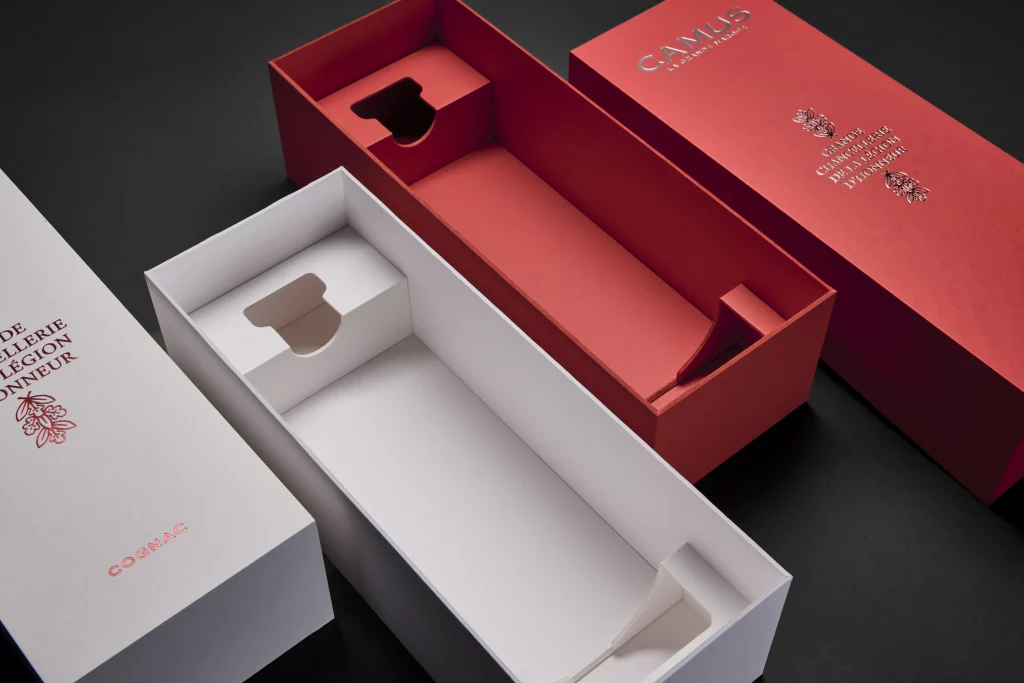
Maestro built his Europe-China hybrid chain based on a simple principle: quality standards are defined once, upstream, and apply equally to both production sites. This means that colorimetric recipes, grammage specifications, finishing tolerances, and validation protocols are identical whether a box is manufactured in a workshop in the Bologna region or in a factory in Guangdong province.
This approach offers a major strategic advantage for brands that need to simultaneously produce small, high-quality runs in Italy—for limited editions or European markets—and large runs in China for global launches or Asian markets. Brand visual consistency is maintained, lead times are optimized, and the client has a single point of contact overseeing both production flows.
This mastery of dual production is documented on our dedicated page, where you will find details of our system and concrete examples of projects carried out in parallel in both areas. To discover all of our packaging projects, our gallery of recent projects illustrates this level of expectation.
Quality is not a matter of geography, it's a matter of method
The prejudice that packaging produced in China is necessarily inferior to European packaging stems from a confusion between a region's industrial potential and the rigor of its regulatory framework. Chinese factories specializing in luxury packaging now possess equipment and expertise comparable to the best Italian or German workshops. What makes the difference is the human presence, the transmission of standards, and the ability to intervene in real time when a deviation is detected.
This is precisely what Maestro offers its clients: not an intermediary who transmits files and waits for production photos, but a manufacturing technician who knows the factories, speaks the same technical language as the foremen, and takes responsibility for the conformity of the delivered batch. If you would like to discuss a luxury packaging project printed in China or a dual-location production, Our team is available for an initial technical discussion. no obligation.
FAQ
What is the difference between a standard AQL inspection and quality control tailored to luxury packaging?
The AQL standard inspection defines statistical acceptance thresholds applicable to all types of products. For luxury packaging, these thresholds are stricter, particularly regarding critical defects related to finishes, colorimetry, and brand visual consistency. A defect considered minor on mass-market packaging can be unacceptable on a premium box intended for a jewelry or high-end perfume boutique.
At what point should you use a third-party audit such as SGS or Bureau Veritas for your product packaging in China?
Third-party audits are particularly recommended when onboarding a new supplier, before entrusting them with a first significant production batch. They allow for independent verification of displayed certifications, actual production conditions, and the maturity of the factory's quality system. For clients subject to CSR obligations, this audit also forms part of the supplier qualification file.
How can we ensure that inks and varnishes used in China comply with REACH regulations for import into Europe?
A safety data sheet (SDS) must be provided by the manufacturer for each ink and varnish used, along with an explicit REACH declaration of conformity. For packaging that comes into indirect contact with cosmetic or food products, testing in an accredited laboratory may be required. Maestro systematically includes this verification in its supplier specifications for products intended for the European market.
Is it possible to produce small batches of luxury packaging in China, or is Chinese production reserved for large volumes?
Minimum order quantities (MOQs) vary considerably depending on the factory and the type of packaging. Some specialized manufacturers accept runs of a few hundred units for premium gift sets or limited editions, provided the specifications are precisely defined beforehand. Maestro, in particular, supports independent premium spirits and cosmetics companies with short runs that have a high perceived value, by articulating Italian production and Chinese production depending on volumes and deadlines.
How much time should be allowed between prototype validation and delivery of a batch of packaging produced in China?
Lead times vary depending on the complexity of the finishes and the volumes involved, but a complete cycle, including prototype, validation, production, and shipping to Europe, generally takes between 10 and 16 weeks. Rigorous production scheduling is essential for launches tied to fixed commercial deadlines such as Christmas, Fashion Week, or a collector's edition. Maestro integrates international manufacturing lead time management into its project tracking from the initial briefing phase.