
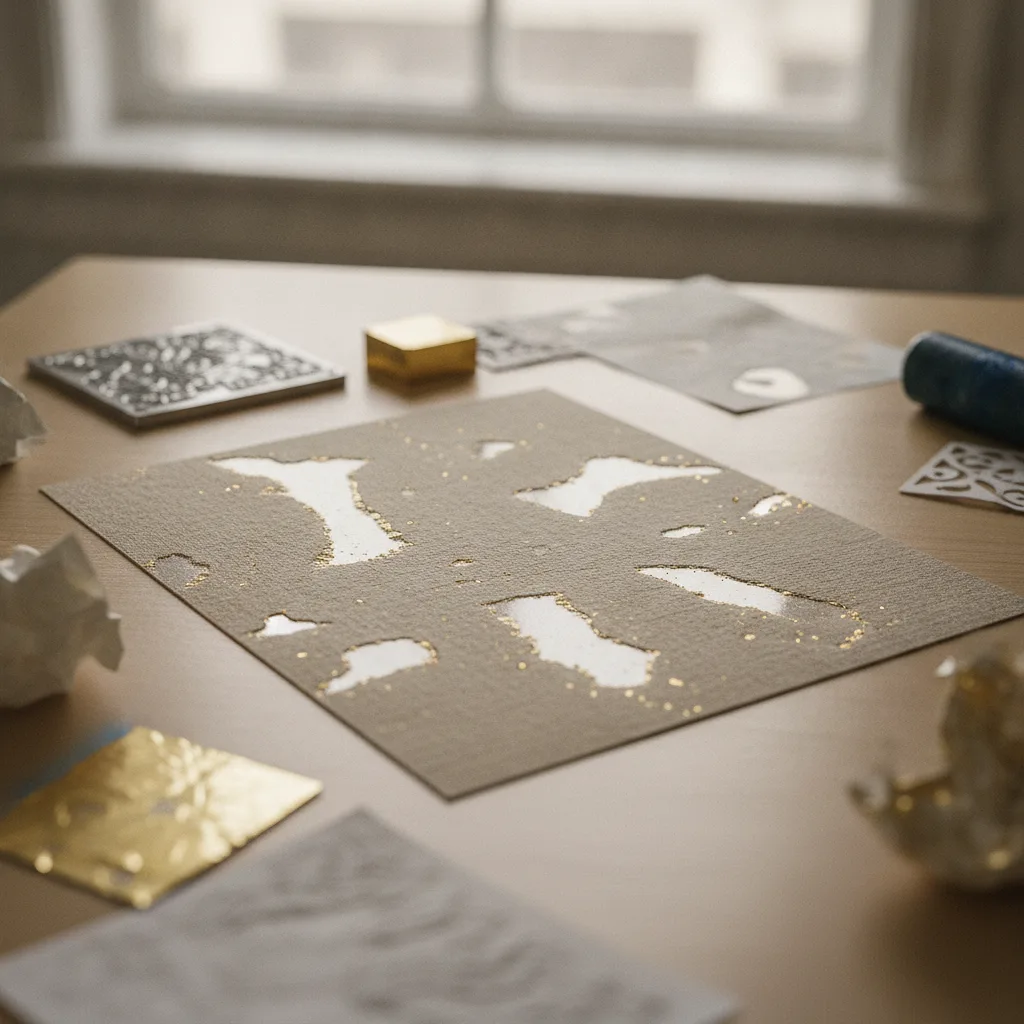
Choosing paper without considering the subsequent finishing process risks preventing foil stamping from adhering properly, causing 3D varnish to collapse within the fibers, or lamination to delaminate during the finishing stage. The compatibility between paper, finishing technique, and printing process—this paper-finish-print compatibility—is not a mere production detail: it is the essential condition for high-end printing that delivers on its visual and tactile promises.
At Maestro, we've been overseeing this decision-making process since 1999, in both offset and digital production, on demanding packaging and publishing projects. This article is designed as a practical reference tool: it combines paper types, post-printing finishing techniques, and printing processes to show you what works, what requires precautions, and what's best avoided.
Paper compatibility, embellishment, printing | Guide
Reading time: ~9 min
- Summary in brief
- Paper families: what each substrate allows or prohibits
- Paper compatibility matrix for printing enhancement
- Offset or digital: the printing process changes the rules of the game
- How to prepare a PDF file for enhancement
- The most common mistakes in paper embellishment
- Digital enhancement and small production runs: what new technologies make possible
- Going further with paper compatibility, embellishment, and printing
- FAQ
Summary in brief
Paper families Understanding the differences between coated, uncoated and specialty papers is the starting point for any embellishment decision.
The compatibility matrix : each technique, from hot foil stamping to screen printing varnish, follows precise rules of substrate and weight.
Offset and digital printing : the printing process determines the finishes available and the precautions to be taken before embellishment.
Preparing the files : a poorly configured spot color or a forgotten overprint is enough to compromise the entire production.
Common mistakes Neglecting preliminary tests, ignoring creasing areas, or underestimating the minimum basis weight are the most common causes of failure.
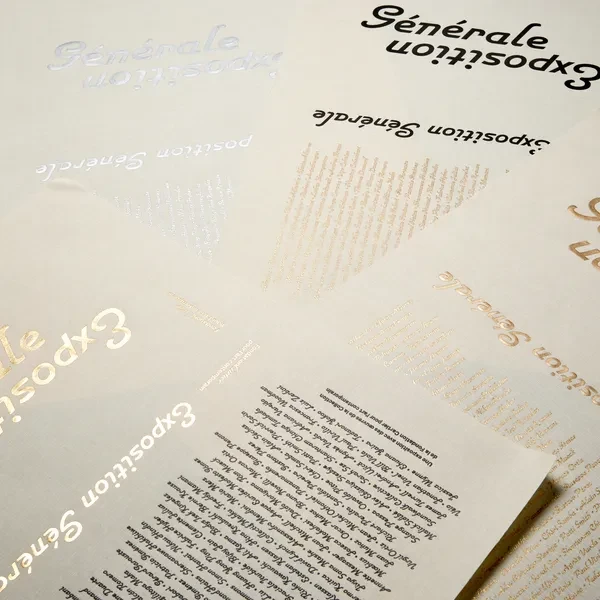
The business press points out that the main finishing processes currently in vogue are the hot foil stamping, embossing and 3D varnishing.
Paper families: what each substrate allows or prohibits
Understanding the behavior of the main substrates
Before addressing the compatibility of paper for printing and embellishment, it's necessary to establish a clear overview of the available substrates. Three main categories can be distinguished, each with very different behaviors when faced with post-printing finishes.
THE coated papers, Whether matte, satin, or glossy, these papers have a treated surface that limits the absorption of inks and varnishes. Their flatness and surface density make them the ideal substrate for most finishing processes: selective UV varnishing, 3D varnishing, lamination, and hot foil stamping. A white coated paper of at least 300 g/m² is recommended for premium finishes requiring rigidity and a brilliant white.
THE uncoated papers, Whether offset, bulky, or specialty papers, these types of paper have a more porous and absorbent surface. This porosity creates significant challenges: lamination adheres poorly, and 3D varnish dilutes within the fibers, losing all definition. However, some uncoated specialty papers can be treated with hot foil stamping or a thick screen-printing varnish, provided the production parameters are adjusted.
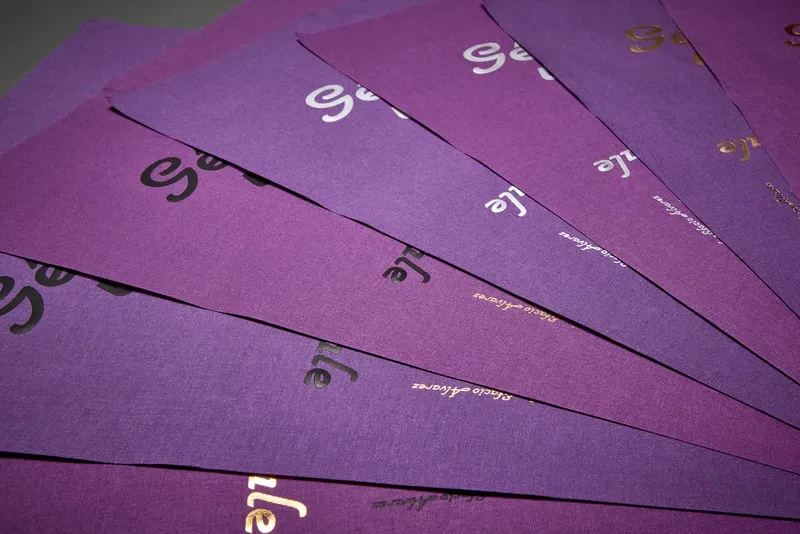
THE premium creative papers, Papers like those in Arjowiggins' Curious Collection occupy a category of their own. Their specific textures, tints and weights open up strong aesthetic possibilities, but require specialized expertise: an intense black paper like Cosmic Black Hole can receive digital gilding or selective UV varnish via systems like the MGI JETVarnish 3D, provided that the parameters are rigorously adapted to the substrate.
Paper compatibility matrix for printing enhancement
Read and use the compatibility matrix
The table below summarizes the approved combinations, those requiring precautions, and those to be avoided. It forms the backbone of this article and can serve as a quick reference during the design phase.
| Beautification technique | Matte/glossy coated paper | Uncoated/bulky paper | Textured craft paper | Minimum recommended weight |
|---|---|---|---|---|
| Hot foil stamping | Compatible (uncoated) | Compatible with precautions | Precautions (variable adhesion) | 300 g/m² |
| Selective UV varnish | Compatible | Not recommended (absorption) | Not recommended | 150 g/m² |
| 3D Varnish | Compatible (optimal) | Not recommended | Not recommended (total absorption) | 200 g/m² |
| Matte/glossy lamination | Compatible | Not recommended (insufficient adhesion) | Not recommended | 135 g/m² |
| Soft touch (lamination) | Compatible (avoid very dark backgrounds) | Not recommended | Not recommended | 135 g/m² |
| Relief screen-printed varnish | Compatible | Compatible | Compatible (smooth or textured) | All weights |
| Embossing | Compatible (matte preferred) | Compatible | Compatible with precautions | 250 g/m² |
Several fundamental rules emerge from this framework. Hot foil stamping absolutely requires uncoated paper at the time of application: if lamination is planned, it must be applied after the foil stamping, never before. 3D varnish, on the other hand, is strictly reserved for coated substrates: on textured paper, the varnish is absorbed by the fibers and the relief disappears, rendering the process pointless and costly. Soft touch varnish deserves special attention on very dark, solid areas subjected to heavy handling, as it is prone to fingerprints and visible markings.
Good to know
Combining soft-touch lamination and hot foil stamping on the same substrate is technically feasible, provided the order of operations is respected: offset printing, then hot foil stamping, then soft-touch lamination. Reversing the steps compromises the adhesion of the foil stamping and can cause delamination during finishing.
Offset or digital: the printing process changes the rules of the game
The compatibility between paper and embellishment cannot be considered independently of the printing process used upstream. Offset and digital printing do not deposit inks in the same way, and this has direct consequences on the available finishes.
In offset printing, The inks are deposited in a thin layer and require drying time before any post-printing finishing. This drying time is critical: a UV varnish applied too soon to insufficiently dry offset ink can cause adhesion problems or uneven gloss. The ISO 12647 standard governs the conditions for color reproduction in offset printing and serves as a reference for validating print quality before embellishment. Matte or glossy coated papers remain the preferred substrate for high-end offset printing followed by embellishment.
In digital printing, Particularly with Konica Minolta technologies or large-format inkjet presses, the ink layer has a different composition that can interfere with certain laminations or varnishes. Preliminary tests are essential to validate adhesion. On the other hand, digital embellishment using systems like the MGI JETVarnish 3D opens up remarkable possibilities for short runs: selective UV varnish, digital foiling, and 3D varnish can be applied directly to digital prints, including on complex specialty papers, with advanced customization and short lead times. Equipment like that from Duplo International also allows for the integration of certain finishes inline with digital production.
How to prepare a PDF file for enhancement
Setting up layers and background colors
A poorly prepared file is the most frequent cause of costly rework in production. The technical preparation of finishing areas follows precise rules that every production manager must master.
The first step is to create a dedicated accompanying color (spot color) for each finish: a layer explicitly named "Hot foil," "Selective varnish," or "Hot foil" depending on the technique used. This color must be defined as an overprint (overprint enabled) to prevent it from obscuring the printed elements underneath. The use of vector objects to delineate the embellishment areas is strongly recommended, as pixelated elements can lead to registration inaccuracies.
Before sending to production, checking the final PDF file in Adobe Acrobat is essential. You must verify the output preview, ensure that spot colors are correctly identified, and that overprinting is enabled on all finishing layers. A thorough checklist at this stage prevents reprints, which can represent significant costs on high-end projects.
Important
Embellishment areas must be designed at a distance from the folds and creases intended for the finishing process. Any gilding or 3D varnish that overlaps a crease line will systematically crack or delaminate at the fold, regardless of the paper quality or the embellishment itself.
The most common mistakes in paper embellishment
Feedback from Duplo International and custom finishing workshops converges on the same recurring points of failure. tests on several papers allow us to check the adhesion and appearance of special finishes before any production launch.
- Do not test the substrate before launch : each paper reacts differently to the heat of stamping, the UV of varnish or the glue of lamination.
- Ignore the minimum weight : paper that is too light will deform under the heat of hot foil stamping or lacks the rigidity to maintain the relief of a 3D varnish.
- Confusing coated and uncoated paper with the naked eye : some creative papers have a surface that resembles a matte coated paper but remains uncoated in depth.
- Neglecting the drying time of offset inks Applying UV varnish too soon after offset printing is one of the most frequent causes of adhesion defects and uneven gloss.
At Maestro, we intervene upstream of these decisions to anticipate technical incompatibilities before the file goes into production. Our role as a technical manufacturing office is precisely to oversee these trade-offs, whether production takes place in Italy or China, to guarantee a result that meets the requirements of the fashion houses and brands we support. You can consult our approach to dual production on our dedicated page to understand how this physical factory supervision concretely changes the quality of the final product: double production.
Digital enhancement and small production runs: what new technologies make possible
One of the most significant developments in recent years has been the accessibility of high-end embellishment to small and medium print runs. Digital embellishment systems like the MGI JETVarnish 3D allow for the application of selective UV varnish, 3D varnish, and digital foiling to short-run print runs, offering advanced customization and turnaround times unmatched by traditional methods.
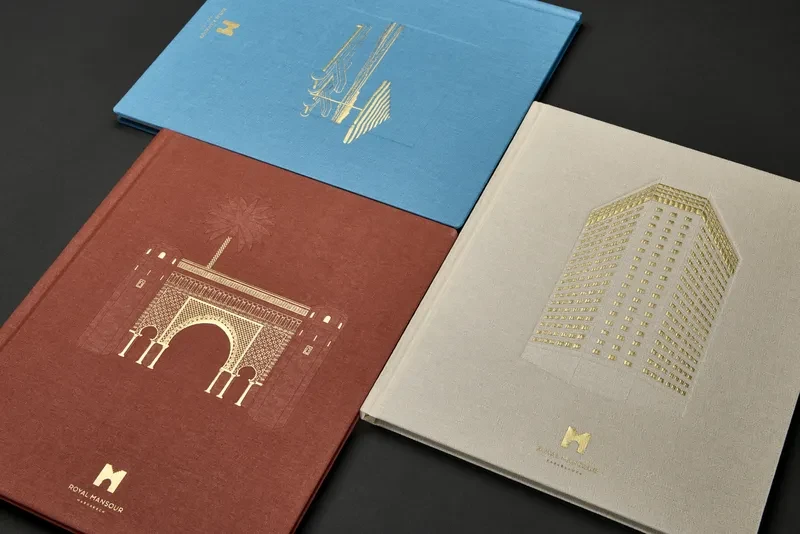
This development is particularly relevant for spirits houses, art publishers, and premium cosmetics brands launching limited editions or collector's sets. It allows access to finishes previously reserved for large volumes, provided compatible substrates are chosen and technical supervision is entrusted to a contact person who understands the parameters of this equipment. For example, the creative papers in Arjowiggins' Curious Collection can receive digital foiling or selective UV varnishing via these systems, even in their most complex colors, provided the settings are adapted to the substrate.
For premium publishing projects, please visit our dedicated page.’premium edition This section presents the types of projects we support, from art catalogs to artist's books, along with the corresponding paper and embellishment combinations. For packaging projects, please visit our page premium packaging details the possibilities in terms of cases, sleeves and nesting boxes with high-end finishes.
Going further with paper compatibility, embellishment, and printing
The compatibility between paper, finishing, and printing process is not a variable that can be left to chance or intuition. It determines the coherence between the creative intention and the final product, the durability of the result over time, and the control of production costs.
Knowing the basic rules, having a reference matrix, and anticipating the necessary tests are the three key steps that distinguish a controlled production from one that is simply a matter of chance. If you would like to submit a project for our technical expertise, our team is available through our page. contact us to analyze your constraints and propose the most relevant combinations.
FAQ
Can several embellishment techniques be combined on the same surface?
Yes, but the order of operations is crucial. The general rule is: printing first, then hot foil stamping, then lamination or varnishing. Certain combinations, such as soft-touch lamination combined with hot foil stamping, are common in luxury packaging, provided this sequence is followed and adhesion is validated by a preliminary test.
What is the minimum paper weight for hot foil stamping on specialty paper?
The standard recommendation is 300 g/m² for uncoated paper intended for hot foil stamping. Below this weight, the paper may warp under the heat of the hot foil press, especially in large areas of foiling. For specialty papers, a preliminary test is essential.
Is 3D varnish compatible with digital printing?
Yes, systems like the MGI JETVarnish 3D are specifically designed to apply 3D varnish to digital prints. Compatibility depends on the substrate used: coated paper is essential for achieving a defined relief. On uncoated or textured paper, the varnish is absorbed, rendering the result unusable.
Why does lamination not adhere well to uncoated paper?
The porous and fibrous surface of uncoated paper does not provide a sufficient base for the laminating adhesive. The result is a film that gradually peels off, especially at corners and in areas of heavy handling. Some special uncoated papers can be laminated with suitable adhesives, but this remains an exception and requires prior technical validation.
What is the difference between embossing and debossing in paper embellishment?
Embossing and debossing both refer to a raised design created by pressure using a die, but common usage distinguishes between debossing (a raised or recessed design without ink or metallic foil) and debossing combined with hot foil stamping. In both cases, sufficient paper weight, generally at least 250 g/m², is necessary to ensure the design retains its shape without tearing.
Do we need a different service provider for printing and for embellishment?
Not necessarily, but coordination between the two stages is critical. When printing and finishing are outsourced to separate providers, the risks of defects related to drying time, registration, or ink compatibility increase significantly. A production office that oversees the entire chain, from printing to finishing, reduces these risks and ensures consistency in the final product.