
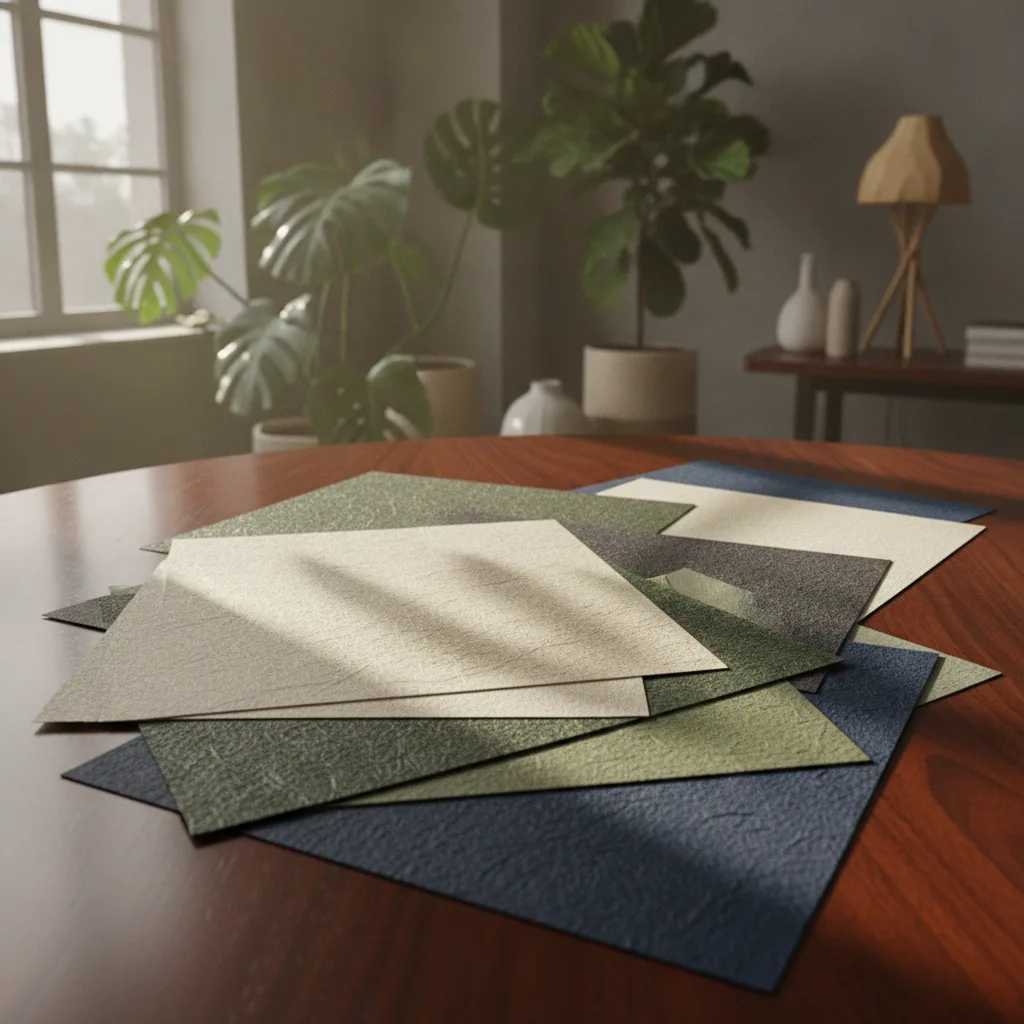
The question still divides many art directors and production managers: is it really possible to choose a luxury eco-responsible paper without compromise for a luxury project without sacrificing visual quality, feel, or durability? The answer, supported by recent developments in creative stationery, is clearly yes.
The ranges available in 2026 prove that uncompromisingly eco-responsible luxury paper is no longer an oxymoron. From post-consumer fibers to transformed agricultural waste, and including FSC and PEFC certifications, the market now offers substrates that technically rival the most demanding virgin papers, while significantly reducing the carbon footprint of a premium printing or packaging project.
Luxury eco-responsible paper without compromise | 2026 Guide
Reading time: ~9 min
- Summary in brief
- Why luxury can no longer ignore sustainable paper
- The major families of eco-friendly papers compatible with luxury
- Comparative technical performance: recycled paper versus conventional paper
- Certifications and labels: what they really guarantee
- Compatibility with premium finishes: what you need to know before specifying
- How to choose eco-friendly paper for a luxury project: the decisive criteria
- Going further with uncompromisingly eco-responsible luxury paper
- FAQ
Summary in brief
Here is an outline of this article to allow you to go directly to what interests you:
- Definition and challenges: what the notion of eco-responsible paper really covers in a luxury context, and why the sector can no longer ignore it.
- The major families of sustainable premium papers: high-end recycled, FSC/PEFC certified, bio-based and eco-designed creative papers.
- Comparative technical performance: what the figures say about CO₂ emissions, water consumption and print quality.
- Certifications and labels: FSC, PEFC, Blue Angel, European Ecolabel, Imprim'Vert, what each one concretely guarantees.
- Compatibility with premium finishes: hot foil stamping, embossing, debossing, spot varnish, what works and what to anticipate.
- How to choose your paper and manufacturing partner for a responsible luxury publishing or packaging project.
Why luxury can no longer ignore sustainable paper
CSR pressure and creative demands
Major fashion houses, art publishers, and premium cosmetics brands face a double bind. On the one hand, their purchasing and CSR departments demand documented proof of fiber traceability, carbon footprint, and compliance with applicable standards. On the other hand, their art directors and production managers rightly refuse to see the visual or tactile quality of a box, catalog, or invitation sacrificed in the name of environmental concerns.
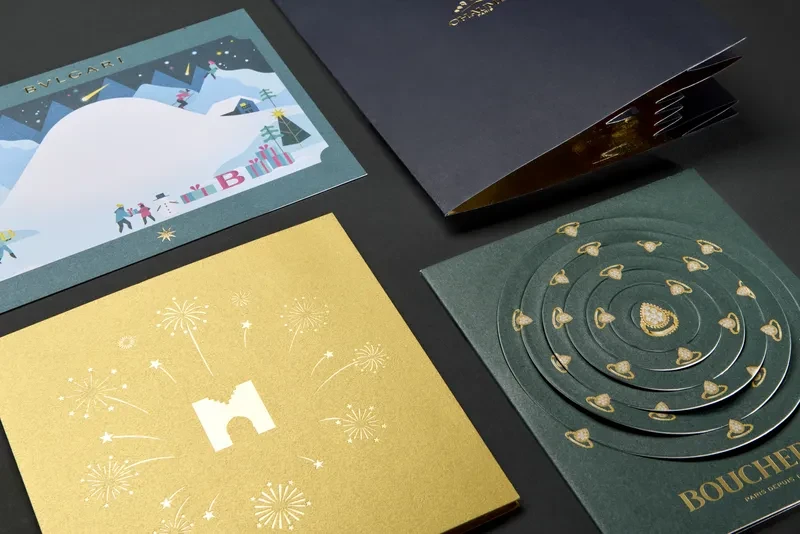
This tension is now largely surmountable. Paper manufacturing has seen major advances: new-generation recycled papers offer dimensional stability, opacity, and printability comparable to conventional virgin papers. Eco-designed creative ranges, such as Favini Crush, Fedrigoni Freelife, and Gmund Used, are specifically designed to meet the demands of high-end projects, from perfume packaging to art books and collector's boxes.
Furthermore, European regulatory requirements and the tender criteria of major groups (LVMH, Kering, L'Oréal Luxe) now systematically include CSR clauses regarding the raw materials used. Having reliable documentation on the origin of the fibers and the paper's life cycle is no longer a differentiating factor: it is a prerequisite.
The major families of eco-friendly papers compatible with luxury
There are several approaches to integrating eco-friendly luxury paper without compromise into a premium printing or packaging project. Each addresses different technical and aesthetic constraints.
High-end recycled papers
Paper is considered recycled if it contains 50% post-consumer fibers (%), meaning fibers derived from paper that has already been used and collected at the end of its life. Premium ranges, such as Nautilus 100% Recycled % or Cyclus Offset, have been specifically formulated for demanding communication applications. Their surface is suitable for both offset and digital printing, and their sheet formation ensures satisfactory visual consistency. The color, often slightly warmer or more natural than conventional bleached paper, can become a deliberate aesthetic choice, consistent with a responsible brand positioning.
FSC and PEFC certified papers made from virgin fibers
For projects requiring highly accurate whiteness or high grammages with a particularly firm paper feel, papers made from FSC- or PEFC-certified virgin fibers remain a relevant option. These certifications guarantee that the fiber comes from sustainably managed forests, with regeneration of stands, respect for biodiversity, and verified social criteria. Fedrigoni Freelife, for example, combines certified fibers and low-impact manufacturing processes, while offering impeccable printability for luxury publishing and packaging projects.
Bio-based papers made from agricultural waste
A third category is emerging with significant growth: papers made from inedible agricultural waste (stems, leaves). PaperWise is the most well-documented representative of this category. According to data published by the manufacturer, this type of paper has an environmental impact 29% lower than that of recycled paper and 47% lower than that of conventional paper made from trees. These papers offer a natural texture and color that perfectly complement the imagery of artisanal brands, niche spirits, and clean cosmetics.
Eco-designed creative papers
Favini Crush perfectly illustrates this category: made from agri-food by-products (grape pomace, lavender, coffee, corn, hazelnuts), this paper offers unique sensory textures, a palette of natural hues, and a wide range of weights. It is compatible with hot foil stamping, embossing, and debossing, making it ideal for premium boxes, event invitations, or art catalog covers.
Comparative technical performance: recycled paper versus conventional paper
Comparative performance table
Here is a comparative table of the main technical and environmental criteria that allow for an objective evaluation of these media:
| Criteria | Plain conventional paper | Premium recycled paper | Bio-based paper (agricultural waste) |
|---|---|---|---|
| GHG emissions (vs. conventional) | Reference | Up to 45 % less | Up to 47 % less |
| Process water consumption | Up to 540 m³ per tonne | Approximately 20 m³ per tonne | Very low (variable data) |
| Offset printability | Excellent | Very good (premium ranges) | Good to very good |
| Dimensional stability | Excellent | Very good | Good |
| Hot foil stamping compatibility | Yes | Yes (depending on weight and sleeping surface) | Yes (depending on weight) |
| Embossing/debossing compatibility | Yes | Yes | Yes |
| Controlled white / shade | Calibrated white | Off-white to natural | A confidently natural complexion |
| Fiber traceability | Variable (FSC/PEFC if certified) | Certified (FSC Recycled) | Documented by manufacturer |
The data on emissions and water consumption are taken from publications by H2Impression and PaperWise, and reflect orders of magnitude recognized in the industry.
Good to know
Reducing water consumption is often the most compelling argument for the CSR departments of large groups: switching from conventional paper to certified recycled paper can represent a saving of more than 500 m³ of water per tonne produced, a figure that can be directly integrated into a carbon footprint or a sustainable development report.
Certifications and labels: what they really guarantee
The main environmental labels
Faced with a proliferation of environmental claims, third-party certifications remain the only reliable tool for distinguishing genuine commitment from mere marketing hype. Here's what each label actually covers in the context of high-end printing.
The FSC (Forest Stewardship Council) and PEFC (Programme for the Endorsement of Forest Certification) both certify that the virgin fibers used come from sustainably managed forests. The main difference lies in their geographical scope and governance: the FSC is generally perceived as having stricter social and environmental criteria, while PEFC is more widespread in continental Europe, particularly for French and Scandinavian forests. For luxury use, both are accepted by buyers from major groups, provided that the chain of custody is complete and audited.
The Blue Angel is the German environmental label that applies particularly to paper products: it covers air and water emissions during manufacturing, waste management, and the absence of certain chemicals. It is especially recognized for recycled paper and is a strong argument in supplier qualification applications.
The European Ecolabel guarantees a low environmental impact throughout the product's entire life cycle, from raw material extraction to end-of-life. It applies to many types of paper and is easily recognizable by public procurement officers and the purchasing departments of listed companies.
Imprim'Vert Imprim'Vert is specific to printers, not to the paper itself. It certifies the management of hazardous waste (solvents, inks, printing plates), the absence of CMR substances, the monitoring of energy and water consumption, and the environmental awareness of the teams. For a production manager or purchasing manager, working with a printer certified by Imprim'Vert is an additional guarantee of control over the production process.
Compatibility with premium finishes: what you need to know before specifying
Embellishment finishes and sustainable papers
One of the most frequent questions asked of a manufacturing office like Maestro concerns the compatibility of eco-friendly papers with embellishment finishes: hot foil stamping, cold foil stamping, embossing, debossing, and spot varnishing. The answer is nuanced but generally reassuring.
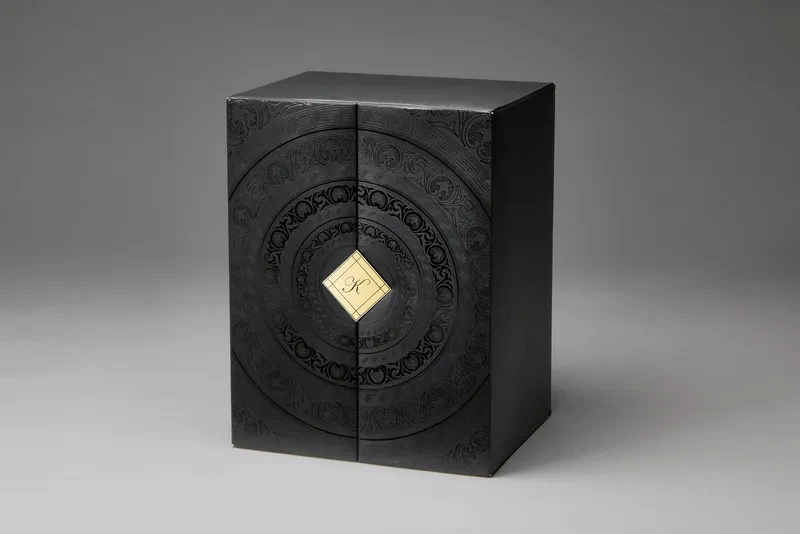
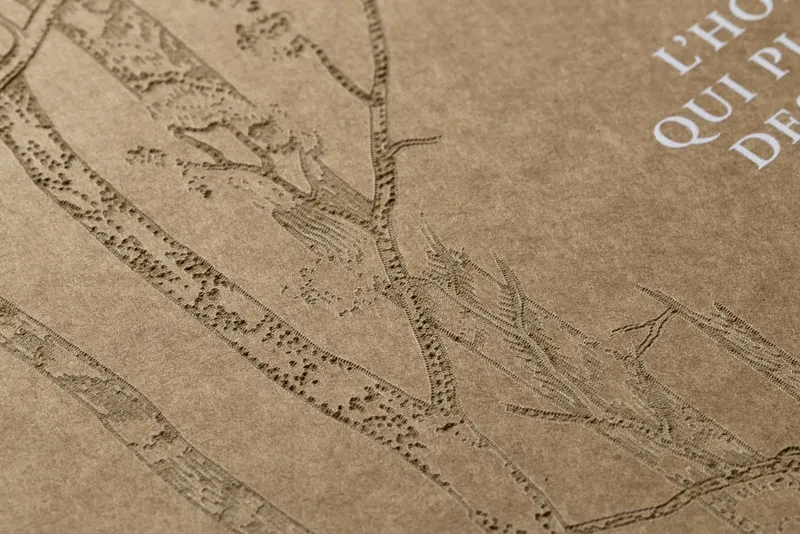
Hot foil stamping works very well on most eco-designed specialty papers, provided the paper weight is sufficient (from 250 g/m² for a hardcover) and the surface is not too porous. Favini Crush and Fedrigoni Freelife papers have been tested and approved for these applications by their respective manufacturers. Embossing and debossing, which rely on the mechanical deformation of the paper, can be applied without major difficulty to these substrates, provided the pressure and shaping tools are adjusted accordingly.
Selective 3D varnishing and low-solvent inks are also compatible with high-end recycled papers, subject to prior validation testing. This is precisely the role of a technical manufacturing office: to anticipate these technical incompatibilities before the project enters production, rather than discovering them at the final proof approval stage.
Key points to remember
Eco-friendly paper is not specified like conventional paper: its natural color, texture, and surface porosity directly influence the rendering of vegetable-based inks and embellishments. Rigorous preliminary consultation, including appropriate photogravure tests, is essential to guarantee color accuracy on these materials.
How to choose eco-friendly paper for a luxury project: the decisive criteria
Key selection criteria
Choosing an eco-friendly, high-end luxury paper without compromise for a publishing or packaging project requires considering several criteria simultaneously. Here are the points to systematically check before confirming a paper specification.
First, define the project's aesthetic priority: a very pure, calibrated white suggests FSC-certified virgin fiber paper like Fedrigoni Freelife; a bold, natural tint opens the door to bio-based papers or the Crush range. Second, verify the fiber certification and request the printer's chain of custody certificate, not just the paper mill's. Third, validate compatibility with the planned finishes by creating a prototype or a proof on the chosen paper before launching production. Fourth, factor in the paper's basis weight and bulk when calculating the final weight of the packaging or book, as these parameters directly influence logistics costs and the carbon footprint of transportation.
At Maestro, we support our clients from the initial briefing phase, integrating these trade-offs into the creative process rather than as a constraint afterward. Our role as a technical manufacturing office, physically present in our Italian factories and on relevant projects in China, allows us to validate these choices under real production conditions, using the actual machines and vegetable-based inks. You can discover our approach on our dedicated page. double supervised production or explore our achievements in luxury packaging and in premium edition.
For independent houses or emerging brands that fear excessively high minimum order quantities (MOQs), it is important to know that several of these premium eco-responsible ranges are available in small and medium series, making them accessible to launch projects or limited editions without sacrificing quality requirements.
Going further with uncompromisingly eco-responsible luxury paper
Get support with paper engineering
Uncompromisingly eco-friendly luxury paper exists, and it is now mature enough to meet the demands of the most ambitious projects: perfume packaging, collector's boxes, art catalogs, and prestigious annual reports. The key to success is not choosing between environmental responsibility and quality, but rather possessing sufficient technical expertise to select the right paper, anticipate manufacturing constraints, and document end-to-end traceability.
It is precisely this paper engineering, at the crossroads of creation and manufacturing, that Maestro has been offering its clients since 1999. If you would like to explore these options for your next project, our team is available via the page contact.
FAQ
Can recycled paper really compete with new paper in terms of visual and tactile appeal?
Yes, provided you select premium ranges specifically formulated for high-end communication uses, such as Nautilus 100 % recycled or Cyclus Offset. These papers offer dimensional stability and printability comparable to virgin papers. The only noticeable difference is a slightly warmer tone, which can be a deliberate aesthetic choice.
What is the concrete difference between an FSC certification and a PEFC certification for a luxury project?
Both certifications guarantee that virgin fibers come from sustainably managed forests. FSC is generally considered more demanding regarding social and environmental criteria, while PEFC is more common for European forests. In both cases, the chain of custody must be complete and verifiable by the buyer, which is a prerequisite in tenders from large corporations.
Are there any wood-free papers suitable for high-end printing?
Yes. Manufacturers like PaperWise produce papers from inedible agricultural waste (stems, leaves). These papers have a significantly lower environmental impact than conventional papers, while offering printability and finishing options suitable for premium projects. Their natural color makes them particularly well-suited for artisanal brands or the responsible luxury sector.
Which eco-friendly papers are compatible with hot foil stamping and embossing?
Most eco-designed creative papers of sufficient weight (250 g/m² and above for a cover) are compatible with hot foil stamping and embossing. Favini Crush and Fedrigoni Freelife have been validated for these applications. A preliminary finishing test is still recommended to confirm compatibility with the specified paper and the tools used in production.
How can a purchasing manager verify that a printer is truly eco-responsible?
The supplier must request FSC and/or PEFC chain of custody certificates from the printer (not just the paper manufacturer), verify the presence of the Imprim'Vert label or an equivalent certification, and request documentation on the management of vegetable-based inks and production waste. A reputable printer should be able to provide these ready-made elements without delay to meet the requirements of a supplier qualification file.
Are premium eco-friendly papers available in small batches?
Yes. Contrary to popular belief, several ranges, such as Favini Crush or the FSC-certified papers distributed by Antalis, are available in packaging suitable for small and medium print runs. This makes them accessible to independent publishers, art publishers, or emerging brands that want packaging or printing that reflects their positioning without being constrained by minimum order quantities reserved for large corporations.
Towards a truly uncompromising luxury eco-responsible paper
By combining premium recycled papers, certified virgin fibers, bio-based substrates, and eco-designed creative papers, it is now possible to design demanding luxury projects without compromising on technical performance or aesthetic excellence. The key lies in precise paper specifications, upstream testing of finishes, and rigorous traceability documentation, ideally supported by a production office capable of communicating effectively with creative teams, paper manufacturers, and printers.