
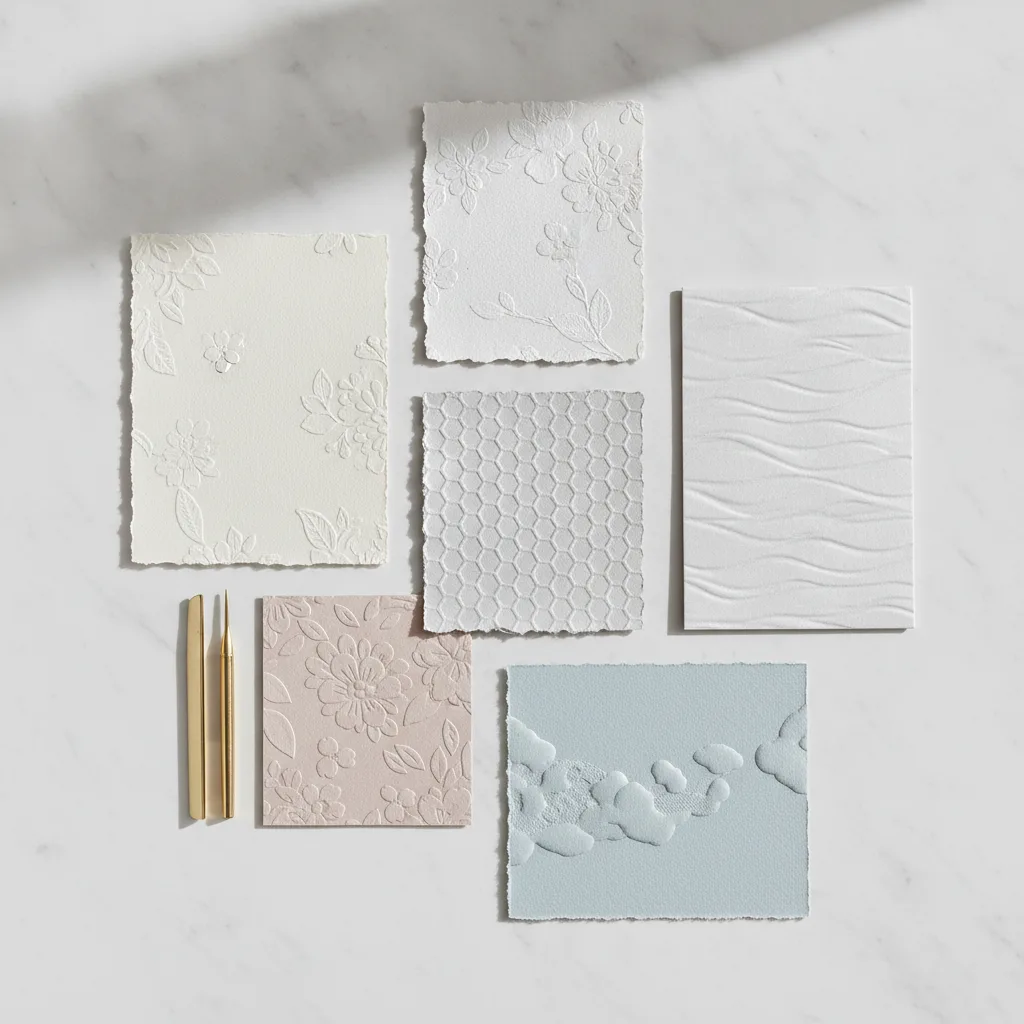
Embossing, debossing, embossing… three terms that come up repeatedly whenever we talk about high-end finish. However, even among professionals, the difference between these processes often remains unclear. Yet, this choice has a direct impact on brand perception, technical feasibility, and the overall cost of the project.
This article provides a clear and practical overview of these techniques: definitions, processes, visual and tactile comparison, as well as advice on choosing the most relevant finish depending on the support and sector.
Embossing, debossing, embossing: understanding the differences to better choose your finish
Reading time: ~11 min
- Definitions of the three techniques
- Difference between embossing, debossing and embossing
- How do embossing, debossing, and embossing work?
- Uses and applications by sector
- How to choose between embossing, debossing and embossing
- Practical checklist
- FAQ
Definitions of the three techniques
What is embossing in printing?
In professional printing, embossing is an embellishment technique that creates a raised pattern on a pre-printed substrate (paper, card, cardboard). The paper is pressed between two complementary dies that permanently deform the fibers: the pattern rises above the visible surface.
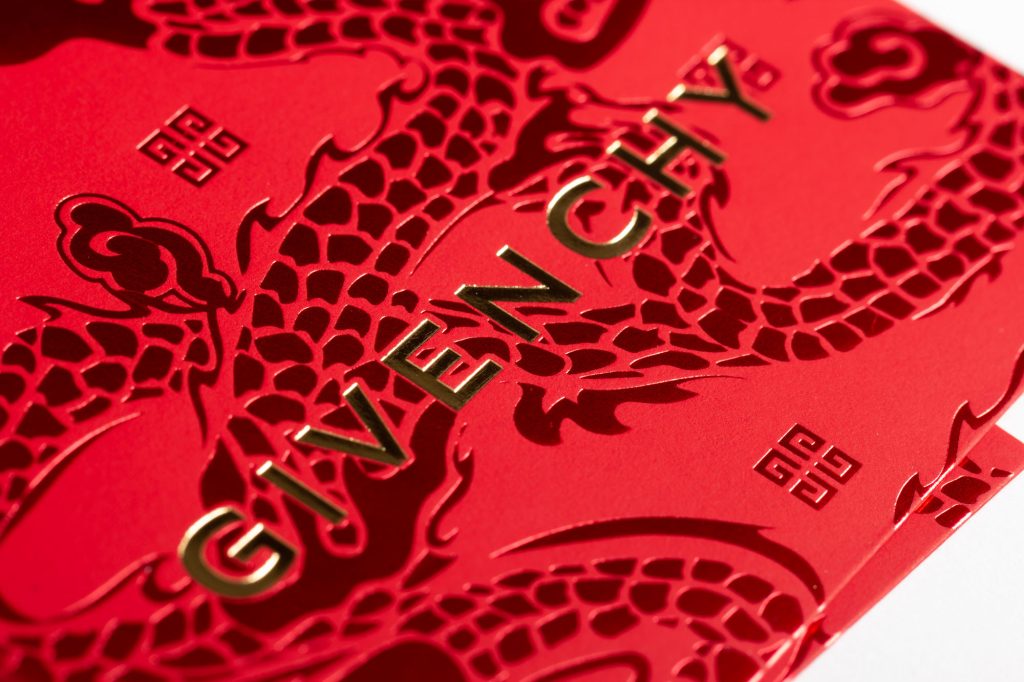
It is used on premium catalog covers, perfume boxes, rigid cases for spirits, and high-end business cards. In workshop jargon, the term embossing often encompasses debossing and, by extension, certain forms of embossing.
Embossing versus embossing
In French, embossing and embossing are very similar. In the luxury goods industry, both create a raised effect on the front of the item using a male/female die system under high pressure. Printers more commonly use the term embossing, while embossing is more prevalent in international trade.
In creative hobbies (scrapbooking, invitations), embossing usually refers to small-scale, manual techniques, either hot or cold, hence the confusion. For luxury packaging, consider embossing and debossing as equivalent in terms of the result: a raised design on the outside.
What is dent removal?
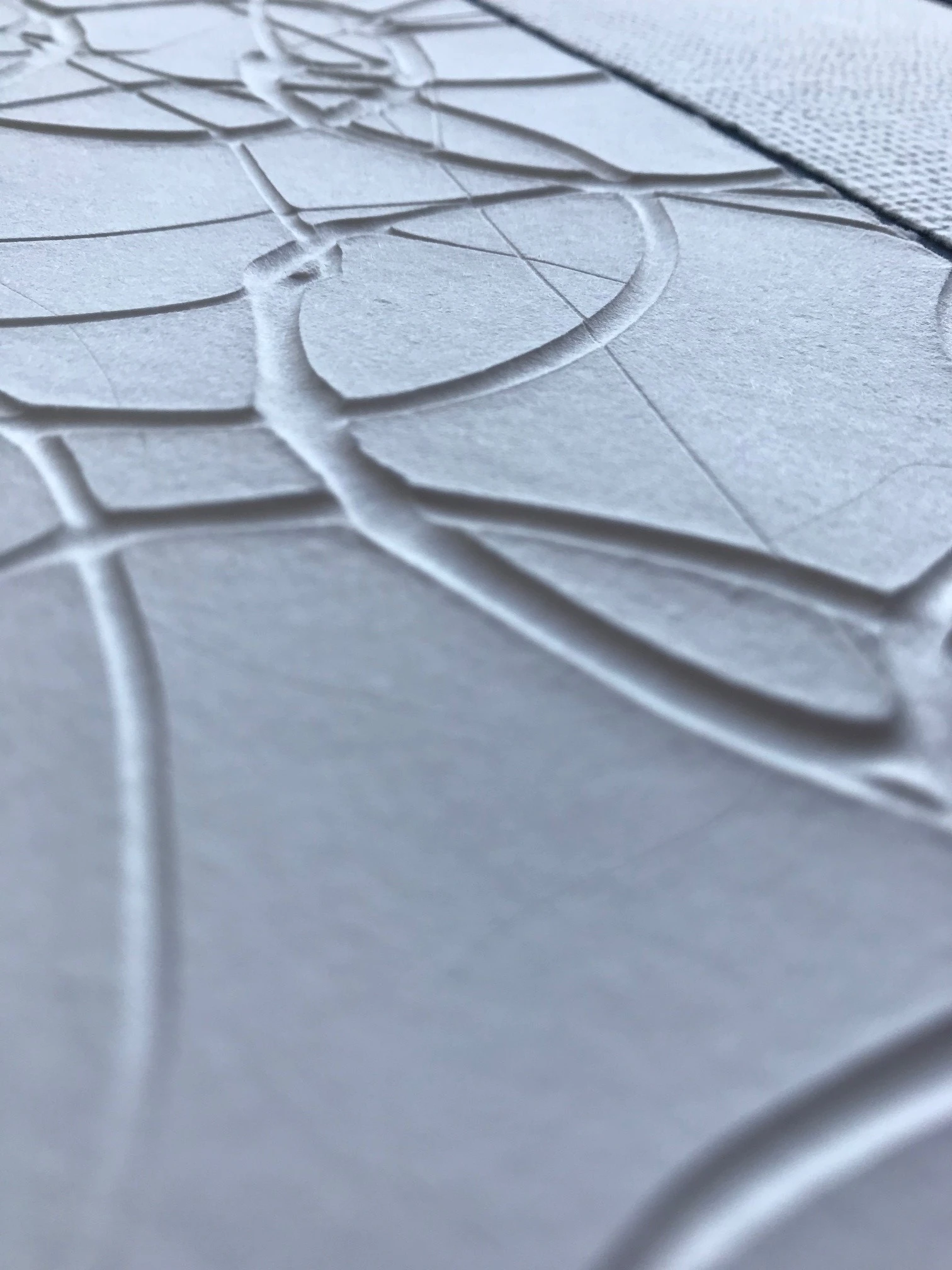
Debossing is the opposite of embossing: the design is pressed into the material. The die cuts into the paper or cardboard, creating a recessed impression. The result, perceived as more subtle and "engraved," is particularly well-suited to art book covers, rigid cognac cases, or jewelry boxes.
On thick substrates, certain configurations limit the impact on the reverse side, a valuable advantage for publishing or front/back packaging.
Difference between embossing, debossing and embossing
Sense of relief and visible face
| Term | Effect on the visible side | Touch perception |
|---|---|---|
| Embossing | The pattern stands out in relief. | Clear volume, clean edges |
| Dent removal | A pattern that is recessed | Engraved effect, more subtle |
In both cases, it's about relief; only the direction changes. The choice is primarily aesthetic and sensory, before being technical.
Terminology in the graphics chain
The terminology varies depending on the industry: in French industrial printing, "gaufrage" remains the primary term; "embossage" is often used synonymously in international trade; "debossage" (or sometimes "fouage") clearly describes the indentation. When briefing, specify the visible side and the type of relief (positive or negative), ideally with a sketch or prototype.
Impact front and back
Any raised surface alters the structure of the support. On thin paper, a pronounced embossing creates a hollow on the reverse side; on rigid cardboard, this effect is less pronounced.
Embossing: suitable for rather thick supports or when the reverse side is not critical (boxes, thick labels, covers not printed on the reverse). Dent removal: useful for maintaining a smoother reverse side or seeking discreet sophistication, particularly in publishing or on double-sided cards.
How do embossing, debossing, and embossing work?
The principle of matrices
- Engraving the design into a metal matrix (magnesium, brass, copper).
- Creation of a counterpart that perfectly matches this shape.
- Positioning of the support between the two matrices.
- Application of controlled pressure, sometimes heated, to deform the fibers and fix the relief.
The depth depends on the thickness and nature of the paper, the hardness of the dies, the pressure, the temperature, and the surface area of the design.
Types of possible effects
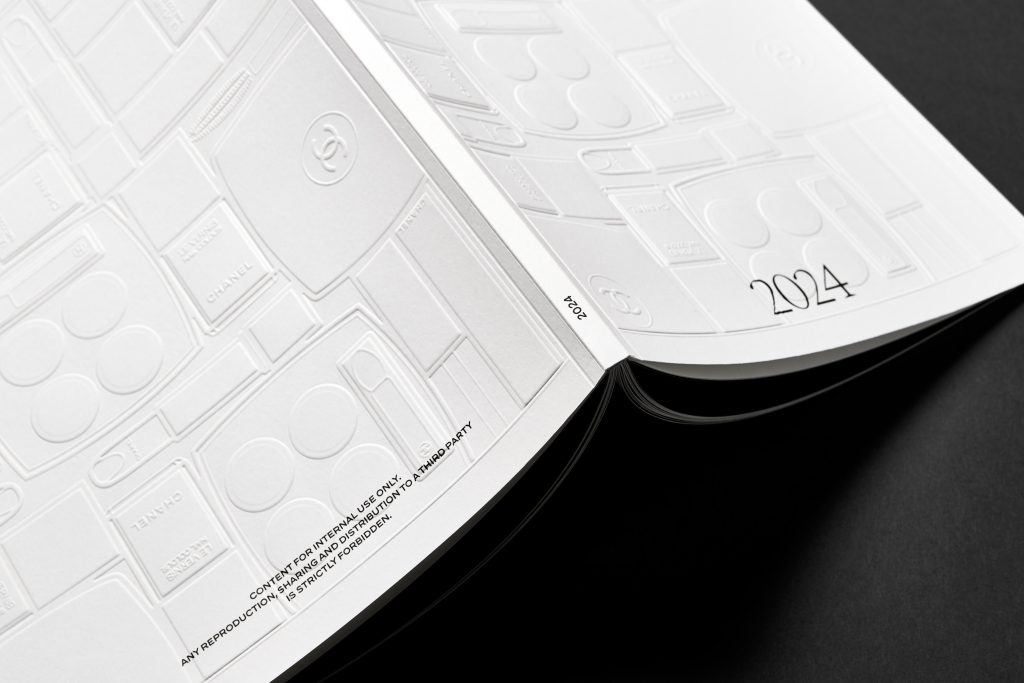
Blind relief: no added ink or metallic foil; everything relies on light, shadow and the texture of the paper. Relief and gilding: The metallic pattern is further emphasized by the volume, creating a precious engraved effect. Relief plus selective varnishing: less frequent but possible, especially with 3D varnishes, provided that the registration is managed well.
Uses and applications by sector
Premium cards, publishing and stationery
On high-end business cards or invitations, embossing highlights the name or monogram, while debossing is suitable for solid designs. In fine art publishing, it evokes the world of engraving and enhances the look of high-quality papers.
Luxury packaging and gift sets
Typical examples include: deep embossing on a cognac house's coat of arms with gilding on the cuvée name; tone-on-tone debossing on a perfume box, visible only in the light; and an embossed texture on the sides of a nesting box to differentiate the brand on the shelf. The choice depends on the motif's purpose, the combinations of finishes, and production constraints.
Corporate communications and press kits
Blind embossing on a title or subtle debossing around a symbol is often enough to give a premium feel without hindering stacking or mailing. It's best to limit embossing to a few key areas to control weight and budget.
How to choose between embossing, debossing and embossing
Aesthetic and sensory criteria
1. Do you want the design to stand out immediately? Embossing, possibly combined with gold foil or spot varnish, will give it more presence. 2. Are you looking for an intimate effect, revealed by touch? Debossing, often tone-on-tone, corresponds to a discreet and sophisticated positioning. 3. What is the role of the back? If it is not very exposed, a pronounced embossing is not a problem; otherwise, opt for debossing or increase the thickness of the support.
Technical and engineering constraints of paper
Confirm the substrate thickness, the distance from folds, the size of the design, and its compatibility with other finishes (gilding, lamination, 3D varnish) beforehand. Technical support from the initial design stage simplifies files, ensures deadlines are met, and avoids back-and-forth approvals.
Practical checklist
Separate layer for raised areas, clearly named. Vector pattern with a unique spot color. Safety margins around edges, folds, cutouts, and creases.
Readability simulation to avoid excessively small font sizes. Clear hierarchy if combining embossing with gilding or varnishing. A technical production office will then translate these intentions into dies adapted to the machines at the production sites, while ensuring repeatability over large production runs.
FAQ
Are embossing and debossing exactly the same thing?
In a French professional context, embossing and gaufrage refer to the same family of techniques, creating a raised pattern that stands out on the visible surface. The distinction is primarily a matter of terminology.
Is debossing more expensive than embossing?
The cost depends primarily on the complexity of the die, the number of machine passes, and the substrate. Debossing is not inherently more expensive; however, certain combined finishes can increase preparation and setup time.
Can these techniques be used on all types of paper?
No. Papers that are too thin or too rigid do not handle deep embossing well. High-quality papers, coated or uncoated card stock with a good finish, and long-fiber substrates react better.
Choosing between embossing, debossing, and embossing isn't simply a matter of deciding between positive or negative relief. It's about balancing presence and subtlety, light and shadow, while considering the graphic production chain, manufacturing facilities, and brand objectives. To learn more about paper engineering and premium finishes, discover: maestro-manufacture.com.
—